
How many days after rain do mushrooms appear
Updated: September 5, 2025 · 8 min read
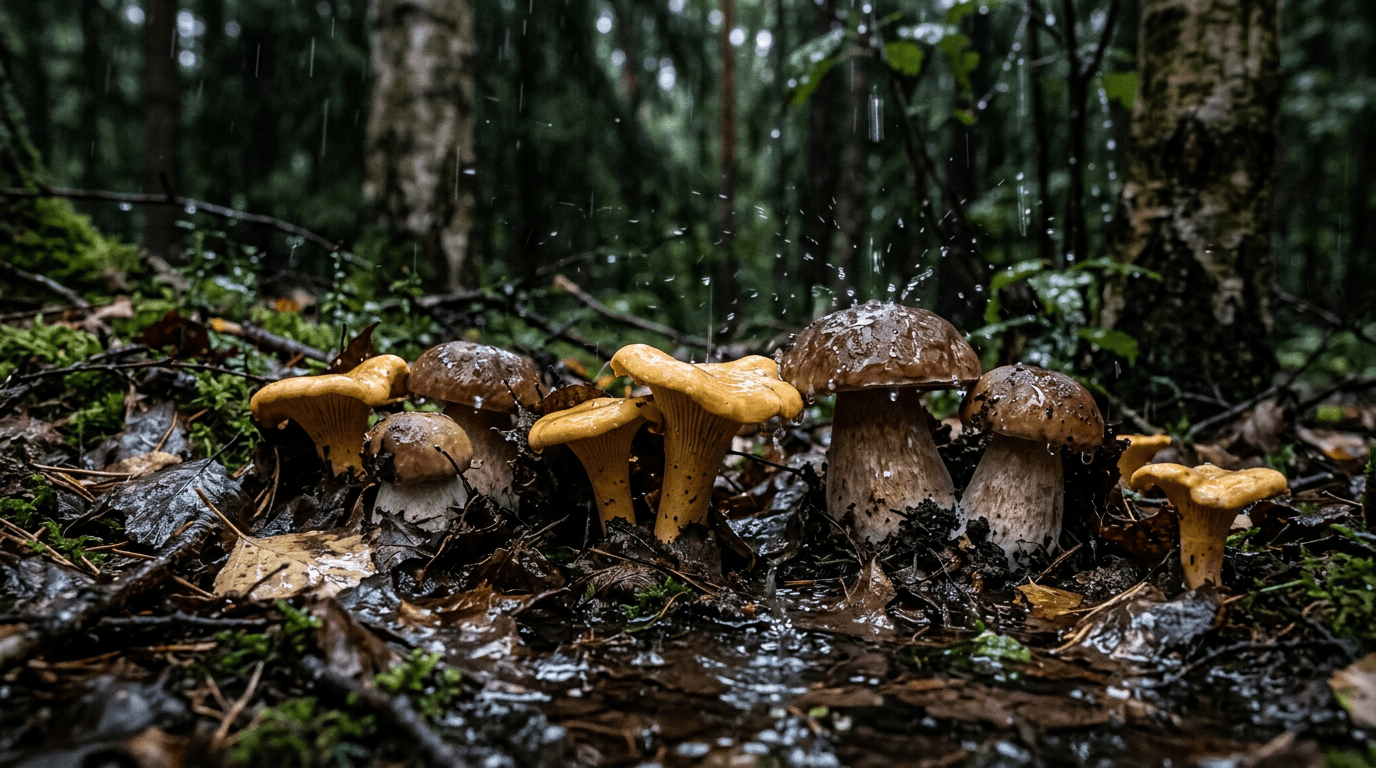
It’s no accident that folk wisdom links rain and mushrooms so closely. Any experienced forager will confirm it: let a good warm rain pass through, and within a few days the forest practically comes alive. The mycelium, hidden away for months in the forest floor, finally gets the moisture it has been waiting for and sends up its fruiting bodies. As the old saying goes — the mushrooms are up.
But here’s the question that torments every foraging enthusiast: how many days after rain do mushrooms grow? Should you rush into the forest tomorrow, wait a week, or play it by ear? The answer depends on the species of mushroom, the type of rainfall, the air temperature, and even what the weather was like before the rain. In this guide we’ll go through it all step by step — with scientific data, a timing table and practical advice.
We’ve compiled information from published research by the Forest Institute of the National Academy of Sciences of Belarus, publications from the Department of Mycology and Algology at Moscow State University, and the experience of foragers with decades under their belts. If it matters to you not simply to rely on luck but to understand when mushrooms appear after rain and why — read on.
How rain triggers mushroom growth
To understand why mushrooms after rain appear only after a certain amount of time, you need to look at the biology of the mycelium. The mycelium is a branching network of extremely fine threads (hyphae) that permeates the soil and the forest floor. In dry weather the mycelium is dormant: it’s alive, but it isn’t building up biomass. According to the Department of Mycology and Algology at Moscow State University, substrate moisture below 40% brings the vegetative growth of the mycelium almost to a halt.
When rainwater penetrates the upper layers of soil (5–15 cm), it sets off a whole cascade of processes. The hyphae begin to absorb water actively, swell and speed up cell division. At the same time the osmotic pressure inside the mycelium’s cells rises — and it is this pressure that lets the fruiting body “shoot up” out of the ground with remarkable speed. The monograph “Fungi: Their Structure and Vital Processes” (Kudryasheva, 2019) cites data showing that a porcini can grow 1–2 cm per day under optimal conditions.
But moisture is only half the equation. To form a fruiting body, the mycelium needs to accumulate enough nutrients. It breaks down the organic matter in the forest floor — fallen leaves, needles, wood — and converts it into building material. This process, too, speeds up in a moist environment. That’s why the longer a spell of favorable rainfall lasts, the more abundant the mushroom flush will be.
Research by the Forest Institute of the National Academy of Sciences of Belarus has shown that the optimal soil moisture for the appearance of fruiting bodies in most edible mushrooms is 60–80%. Moreover, the mycelium is able to “remember” favorable conditions: if it is well developed and has received enough moisture in the preceding weeks, mushrooms appear more quickly after rain. That’s precisely why the harvest is always more reliable at proven mushroom spots.
How many days to wait for mushrooms: a table by species
One of the most common questions is: how many days after rain can you pick mushrooms? Below is a table compiled from foragers’ observations and data from mycological research. It’s important to understand that these are average figures. In any given location the timing can differ noticeably — it’s affected by soil type, forest density, elevation above sea level, proximity to bodies of water, and even which way the slope faces. In southern regions mushrooms appear faster; in northern ones, slower. On sandy soils the moisture is gone within a day; on clay soils it lingers for a week. So treat the table as a rough guide rather than a precise schedule — you’ll work out your own adjustments over time for each familiar forest.
| Mushroom species | Time after rain | Optimal t° | Notes |
|---|---|---|---|
| Suillus (slippery jacks) | 2–3 days | 15–20 °C | Among the first to appear, especially in young pine stands |
| Russulas | 3–5 days | 12–20 °C | The most “responsive” — they grow in almost any conditions |
| Birch boletes | 4–6 days | 14–20 °C | Gain mass quickly, but also get wormy fast |
| Chanterelles | 4–7 days | 16–22 °C | Prefer damp, mossy spots and grow in waves |
| Aspen boletes | 5–7 days | 14–20 °C | Prefer mixed forests with aspens and birches |
| Honey mushrooms | 5–7 days | 10–18 °C | Autumn honey mushrooms can grow at lower temperatures |
| Porcini | 7–10 days | 15–22 °C | Require steady warmth and humidity |
| Milk caps | 7–12 days | 12–18 °C | Appear later than others and often hide under leaf litter |
As the table shows, the quickest to respond to rain and mushrooms are the species with small fruiting bodies — suillus and russulas. Larger species like porcini and milk caps need more time to form their massive fruiting bodies. Experienced foragers plan several outings: the first around 3–4 days later for the “small fry,” and the second a week on for the choice mushrooms.
What kind of rain mushrooms need
Not just any rain qualifies as a mushroom rain. In folklore the term long ago took on a specific meaning: a warm, drizzly summer rain, often with the sun still shining. And here folk wisdom lines up with science. Let’s look at which types of rainfall are most effective for mushrooms.
A warm drizzly rain (a mushroom rain). The ideal case. Fine droplets slowly soak the forest floor, needles and moss. The water reaches a depth of 10–15 cm, where the bulk of the mycelium lies. If such a rain falls for several hours — better still, on and off over a day or two — the mycelium gets evenly moistened. It’s after rainfall like this that foragers record the most abundant flushes.
A brief downpour. Less effective than it seems. An intense flow of water doesn’t have time to soak in — most of it runs off the surface, especially on slopes and in coniferous forests with a thick carpet of needles. After a downpour the top layer quickly dries out in the wind and sun. That said, if the downpour is followed by cloud cover and moderate temperatures, the effect can be good.
Prolonged rains lasting several days. You’d think the more water the better. But no. Days-long rains waterlog the soil and force the oxygen out of it, and the mycelium, like any living organism, needs aeration. According to research by the Forest Institute of the National Academy of Sciences of Belarus, once soil moisture exceeds 90% the growth of fruiting bodies slows down. On top of that, prolonged rains are often accompanied by a drop in temperature, which further holds back mushroom development.
A cold autumn rain. In autumn the character of the rain changes: the air temperature falls and the rainfall becomes drawn-out and chilly. Under such conditions most summer species no longer respond to the moisture. For autumn honey mushrooms and milk caps, however, this is exactly the right weather — 10–15 °C is enough for them. So in autumn, focus less on the rain itself and more on a steady temperature above 8 °C.
Temperature after the rain — the second key factor
Even a perfect mushroom rain won’t deliver if the temperature drops below 10 °C afterward. The mycelium is a living organism whose growth rate depends directly on the temperature of its surroundings. The monograph “Fungi: Their Structure and Vital Processes” (Kudryasheva, 2019) presents a so-called “growth curve”: at 5 °C the division of mycelial cells practically stops, at 10 °C it proceeds slowly, and the peak of activity falls in the 18–22 °C range.
That’s why the most productive periods are warm days following summer rains. In July and August, when the daytime temperature stays around 20–25 °C and the nighttime temperature doesn’t fall below 12–15 °C, mushrooms grow at their fastest. Suillus can shoot up in a couple of days, and a birch bolete reaches market size in 3–4 days.
The soil temperature deserves special attention. It changes more slowly than the air temperature, and it’s soil temperature that the mycelium “goes by.” Even if the night cooled to 8 °C, but the daytime sun warmed the ground to 16–18 °C, the mycelium keeps growing. Conversely, if a sharp warm-up follows a long cold spell, the soil stays cool for several more days and the mushrooms will appear later than expected.
A practical tip: pay attention not only to the current forecast but also to the average daily temperature over the last 3–5 days after the rain. If it has stayed steadily above 15 °C, you can confidently plan an outing. If it’s swinging between 8 and 22 °C, wait for it to settle. Spores may germinate even amid swings, but the fruiting bodies will be small and few.
Why mushrooms sometimes fail to appear after rain
Every forager has found themselves in this situation at least once: a good rain has passed, it’s warm and damp — and yet the forest is empty. Disappointing. But there’s always an explanation. Here are the main reasons why knowing when to pick mushrooms after rain isn’t always a simple question.
1. A long drought before the rain. If the forest hasn’t had moisture for 2–3 weeks, the mycelium may partly die off or slip into deep dormancy. A single rain is sometimes not enough to “wake it up.” In such cases the mycelium first rebuilds its network and only then forms fruiting bodies. The delay can run to an extra 2–3 weeks.
2. A sudden cold snap. The temperature dropped below 8–10 °C right after the rain and the mycelium “froze.” There’s water in the soil, but no warmth. The mycelium waits. If a warm-up comes within a few days, the mushrooms will still come, just with a delay. If the cold drags on, you’ll have to wait for the next “rain + warmth” cycle.
3. Strong wind after the rain. Wind is a forager’s enemy. It quickly dries out the top layer of soil and forest floor. Even if the rain was heavy, 1–2 days of strong wind under the sun can reduce the effect to nothing. The moisture evaporates before the mycelium has a chance to use it.
4. A short or weak rain. A rain that soaked only the top 2–3 cm of soil doesn’t reach the zone of active mycelium. For most species the moisture needs to penetrate to a depth of at least 8–10 cm. According to the Department of Mycology and Algology at Moscow State University, this requires at least 10–15 mm of rainfall.
5. An exhausted mycelium. If mushrooms are picked from the same spot every year and in large quantities, the mycelium can become exhausted. It needs resources — decomposing organic matter and symbiosis with trees (for mycorrhizal species). If the forest has been “cleared out” or the partner trees have died, no amount of rain will help. That said, this is more of a long-term problem than the cause of a single poor harvest.
How to track rainfall for your mushroom spots
The main challenge is figuring out whether it actually rained in the very forest you’re planning to visit. A city forecast is often useless: summer rains are local, and 20 km outside town the picture can be completely different. The classic approach is to call friends out in the countryside or check satellite rainfall data.
There’s a more convenient option. The rainfall map in SkyForest shows exactly where it has rained over the past few days — tied to specific forest areas. You don’t see abstract “rainfall across the region,” but precise data for your own mushroom spots. And the weather monitoring automatically compares the current conditions with your best mushroom day — so you immediately understand how close the situation is to ideal right now.
Say that three days ago the Lahoisk district got 18 mm of rain, with an average daily temperature of 17 °C. By our table, in just a day you can head out for suillus and russulas, and in 4–5 days for birch boletes. Instead of guesswork — a concrete plan. That’s exactly why we built SkyForest: so that foraging is a considered decision rather than a lottery.
Frequently asked questions
How many days after rain can you go mushroom picking?
It depends on the species. Suillus appear as early as 2–3 days after a good rain, russulas in 3–5, honey mushrooms in 5–7, and porcini in 7–10 days. The key condition is warm weather (15–20 °C) following the rainfall.
What kind of rain is best for mushrooms?
The ideal “mushroom rain” is warm, drizzly and long-lasting. It soaks the forest floor and the top layer of soil evenly. A heavy downpour is less effective: the water doesn't have time to soak in and simply runs off the surface.
Why do mushrooms sometimes fail to appear after rain?
There are several reasons: temperatures below 10 °C after the rainfall, a long drought before the rain (the mycelium may have dried out), strong winds that dried the soil, or a rain too brief to soak the forest floor.
Do mushrooms grow after a cold rain?
A cold rain at temperatures below 8–10 °C does almost nothing to stimulate the growth of fruiting bodies. Mycelium develops actively in the 15–22 °C range. The exception is autumn honey mushrooms, which are content with 10–15 °C.
How can you tell whether it rained in a specific forest?
Use the rainfall map in SkyForest — the service shows exactly where and how much rain has fallen over the past few days. This is more precise than a general city forecast, since summer rains are often highly localized.
Read also
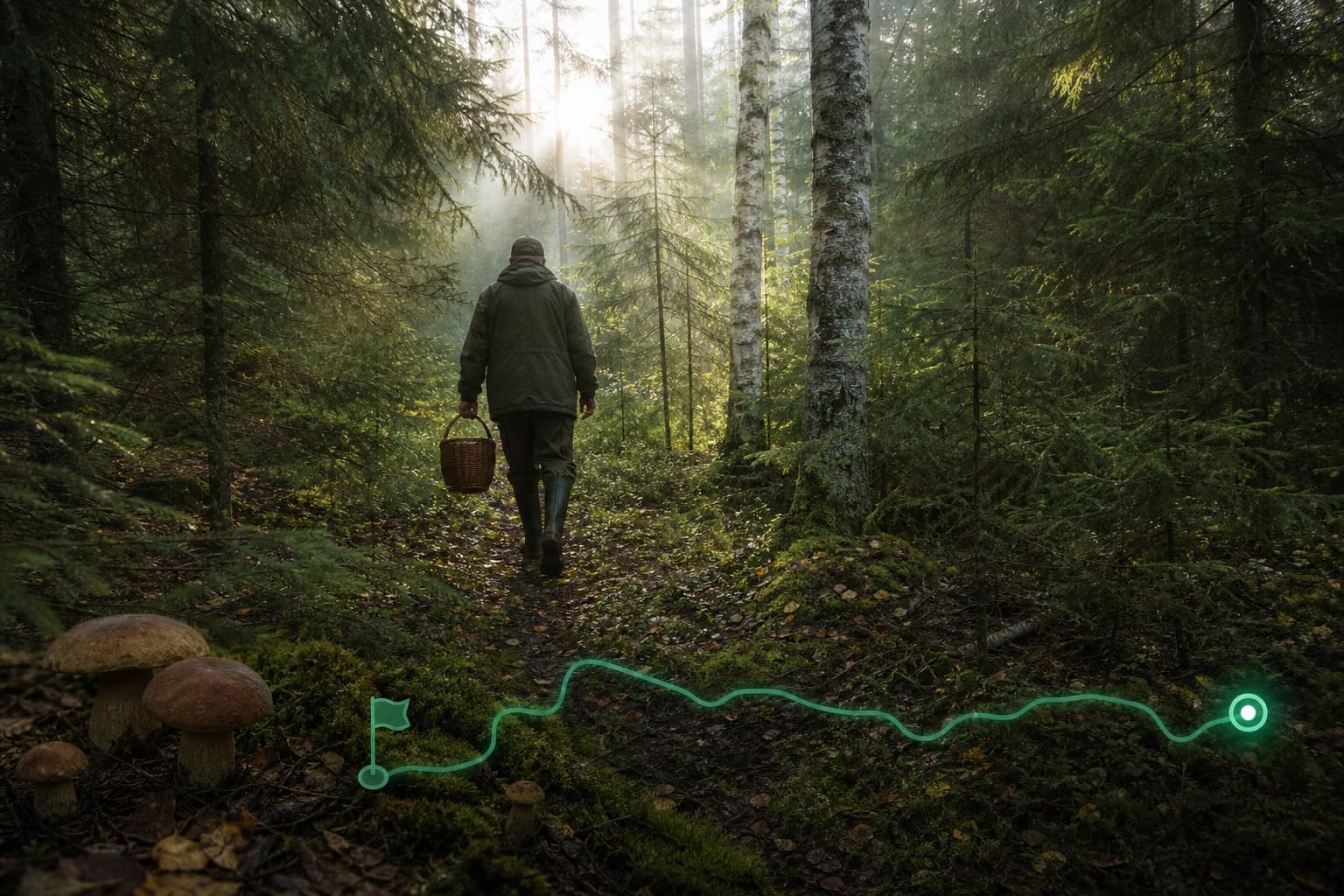
How not to get lost in the forest: the Track feature in SkyForest
Track remembers your forest entry point, draws your path on the map and points the way back — even offline.
7 min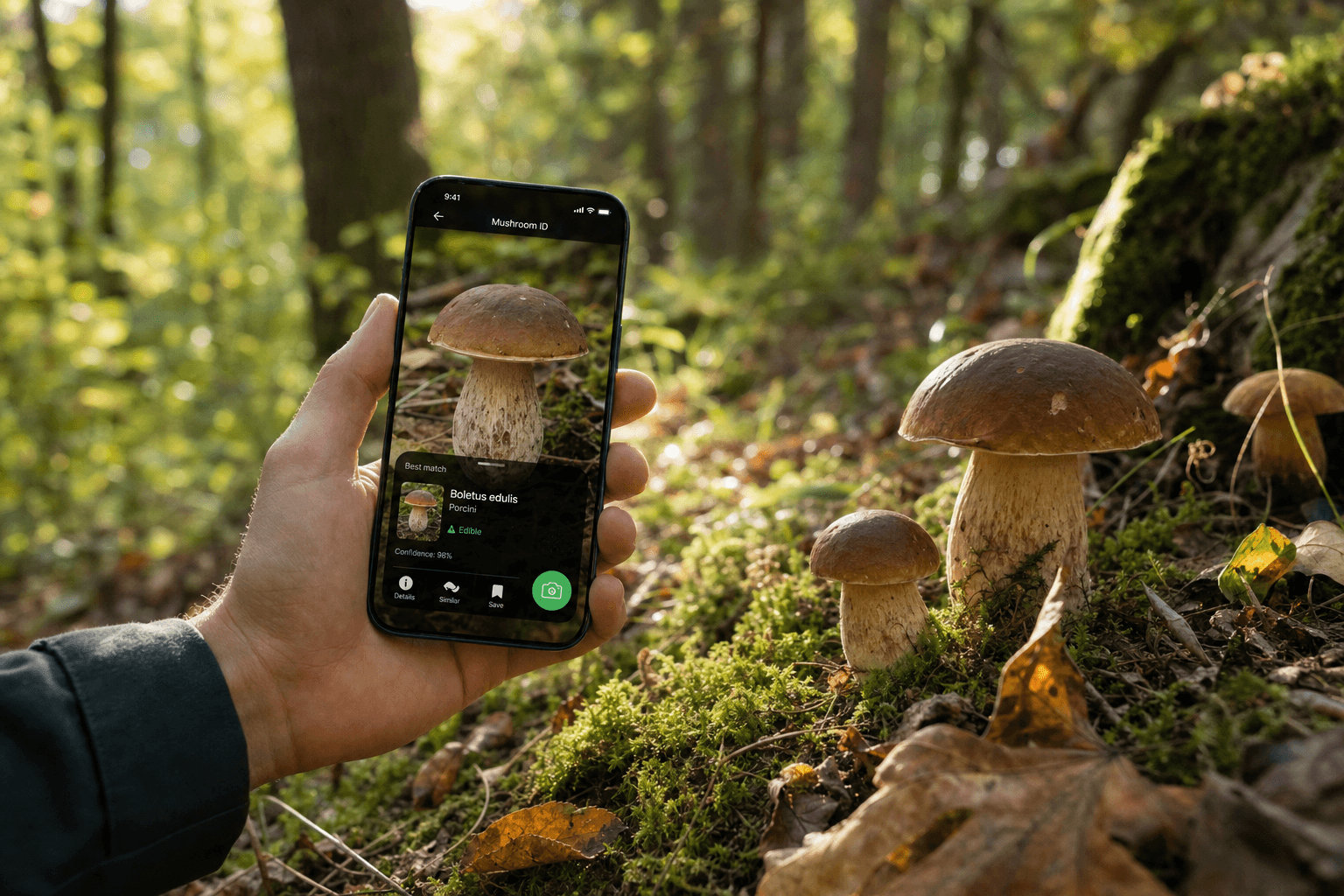
How to identify a mushroom from a photo: apps, neural networks and key features
How accurate identifiers are, what to photograph and which features to check. Plus the SkyForest identifier on Telegram.
11 min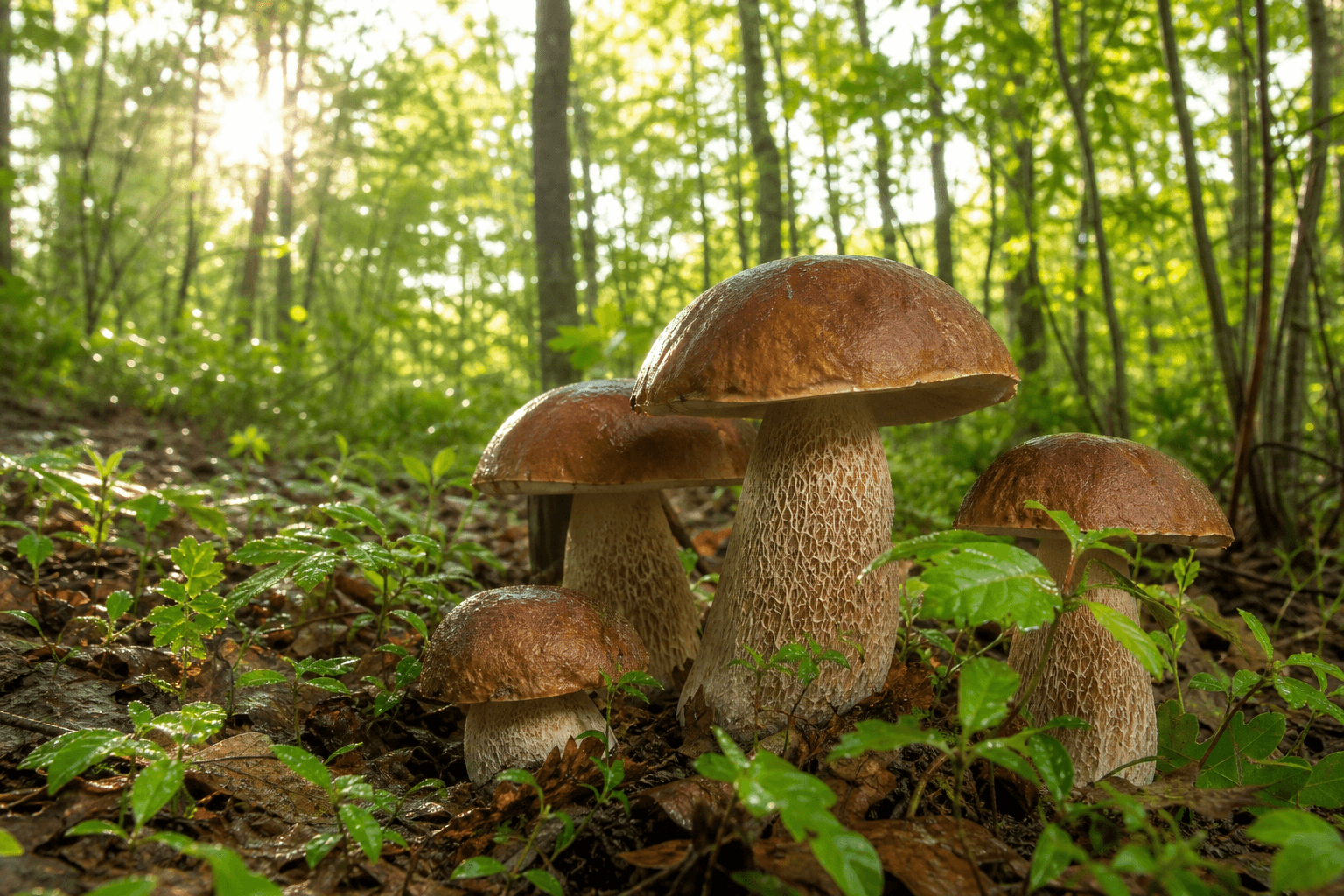
The first May porcini: where and when to find the early cep
The summer cep is the earliest porcini. Timing, locations, weather and how to tell it from look-alikes.
10 min
Weather for mushrooms: at what temperature and humidity mushrooms grow
Which weather conditions are ideal for mushroom growth. Temperature, humidity and rainfall — what matters most.
12 min
When it's time to head to the forest: 7 signs the mushrooms are up
Practical signs that the season has started. Soil temperature, first finds and other clues.
6 min
Which forest to search for mushrooms: coniferous, deciduous or mixed
Which mushrooms grow where: ceps in pine forests, birch boletes near birches. A guide to forest types.
10 min
Where mushrooms grow in Russia and Belarus
Regions, forests and specific spots for mushroom foraging. A map of mushroom locations and planning tips.
12 minFind out when the mushrooms are up in your area
SkyForest analyzes rainfall, temperature and humidity — and points you to the best day for foraging. Registration is free.
Try SkyForest →