
Lion’s Mane: the brain mushroom — what the science says
Updated: March 11, 2026 · 18 min read
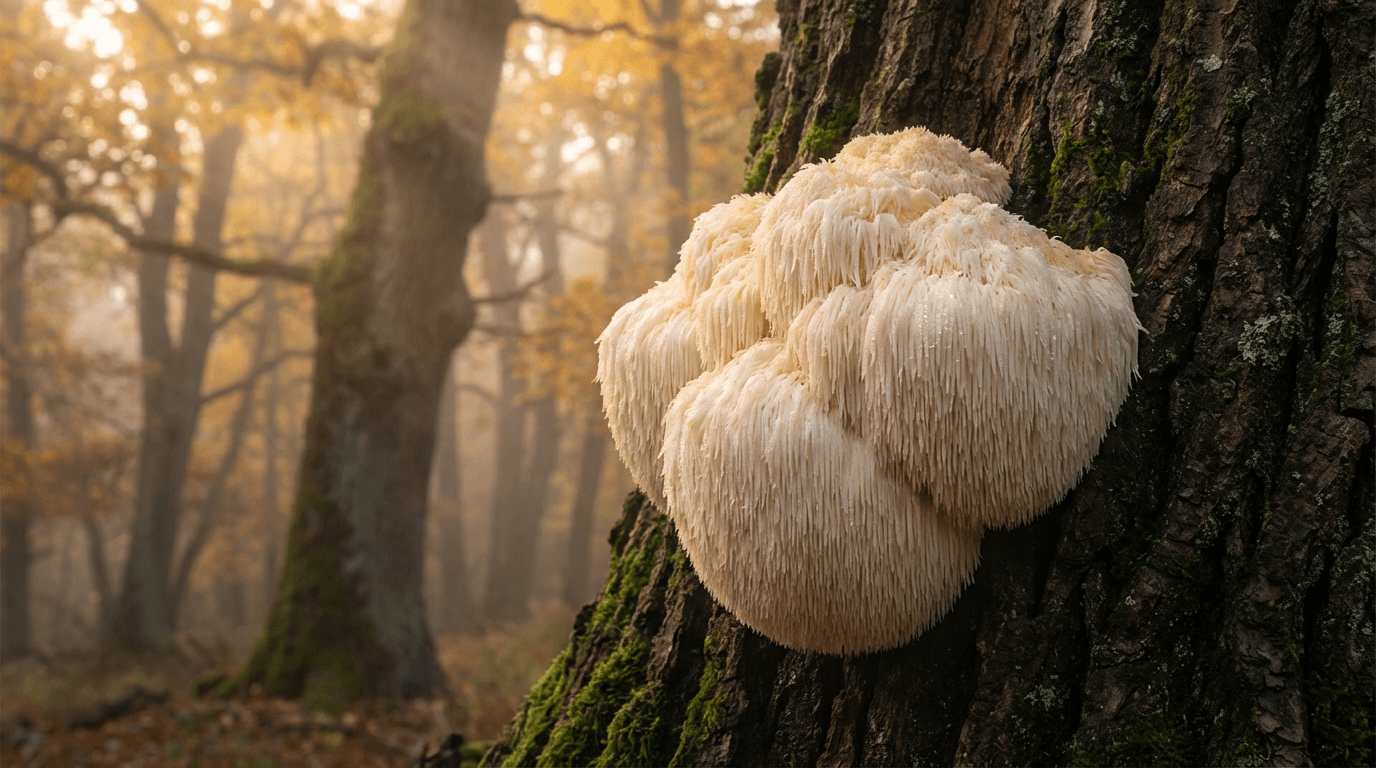
Lion’s Mane (Hericium erinaceus), also known as «lion’s mane», «yamabushitake» and «bearded tooth», is one of the most unusual mushrooms on the planet. White, shaggy and resembling a coral or the beard of a fairy-tale elder, it is unmistakable in the forest. But its appearance is far from the main point. Over the past 20 years this mushroom has become the subject of dozens of clinical studies, and the results are striking: improved memory, reduced anxiety and protection of the nervous system.
Online, there is a lot of marketing around Lion’s Mane and few hard facts. Some sellers promote fruiting-body powder, others mycelium extract, and still others tinctures. Who is right? What has actually been confirmed by science? Which compounds work, and where are they found? In this article we review only peer-reviewed clinical studies in humans — no «mouse» data and no advertising promises.
For fans of mushroom foraging, Lion’s Mane is a special find. It occurs in deciduous and mixed forests of Russia and Belarus, growing on the trunks and stumps of oak, beech and birch. It is not easy to find, though — the species is rare and listed in the Red Data Book in many regions. But every mushroom hunter should know about it.
Two classes of compounds: erinacines and hericenones
The main scientific intrigue of Lion’s Mane lies in its chemistry. The mushroom produces two fundamentally different classes of bioactive terpenoids, and they are distributed across different parts of the organism.
Erinacines are cyathane diterpenoids found predominantly in the mycelium. This is the key point. A 2025 genomic study (PMC11969743) confirmed that the erinacine biosynthesis genes (eri genes) are active in the mycelial phase but suppressed in the fruiting bodies. Erinacines are practically undetectable in the fruiting bodies of Lion’s Mane. The mycelium is the only significant source of these compounds.
Hericenones are another class of terpenoids, found in the fruiting bodies (what we see as the «mushroom» in the forest). Hericenones also stimulate the synthesis of nerve growth factor (NGF) and have immunomodulatory and antitumor activity. But — and this is crucial — there is as yet no clinical evidence of their effect on cognitive function, unlike the erinacines from the mycelium. Direct evidence that hericenones cross the blood-brain barrier is also insufficient.
Why does this matter? Because the vast majority of supplements on the market are powder made from fruiting bodies. It contains hericenones, polysaccharides and beta-glucans — compounds beneficial for immunity. But if your goal is improved memory, concentration and neuronal protection, you need mycelium enriched with erinacines. It was mycelium that was used in the key clinical trials in humans.
| Parameter | Erinacines (mycelium) | Hericenones (fruiting body) |
|---|---|---|
| Source | Mycelium | Fruiting body |
| NGF stimulation | Yes, strong | Yes, moderate |
| Cognitive function | Clinically confirmed | Not confirmed |
| Antidepressant effect | Clinically confirmed | Partial data |
| Immunity | Yes | Yes, pronounced |
| Antitumor activity | Limited data | Confirmed |
Clinical studies in humans
Let’s get specific. Below are only randomized controlled trials in human participants, published in peer-reviewed scientific journals. No rats, no test tubes and no «traditional medicine».
Improved cognitive function in mild impairment
A double-blind, placebo-controlled study. 30 Japanese participants aged 50–80 with diagnosed mild cognitive impairment. One group received tablets containing Lion’s Mane powder (4 × 250 mg, three times a day — 3000 mg/day in total), the other a placebo. The course lasted 16 weeks.
Result: as early as week 8, the Lion’s Mane group showed a statistically significant improvement in cognitive function on the HDS-R scale (the revised Hasegawa Dementia Scale). Scores continued to rise through weeks 12 and 16. No side effects were recorded. But here is an important point: four weeks after the supplement was stopped, scores began to decline. This means Lion’s Mane works while you are taking it — it is not a «cure and forget» remedy.
Reduced depression and anxiety
A randomized, double-blind study. For 4 weeks, 30 women ate cookies containing Lion’s Mane powder (500 mg per cookie, 4 cookies a day) or placebo cookies. Measures of depression (CES-D) and indefinite complaints (ICI) were assessed.
Result: a significant reduction in depression and anxiety in the Lion’s Mane group. Scores for irritability, anxiety and concentration improved especially markedly. The authors note that the mechanism may be linked not only to NGF stimulation but also to other neurotropic effects — in particular, effects on serotonin and dopamine levels.
Improved mood and sleep in people who are overweight
77 volunteers who were overweight or obese and experienced mood and/or sleep disturbances. 8 weeks of Lion’s Mane supplementation alongside a low-calorie diet.
Result: reduced depression and anxiety and improved sleep quality. An increase in pro-BDNF (the precursor of brain-derived neurotrophic factor) was also recorded — a protein critically important for the growth and survival of neurons. Interestingly, the effect persisted for 8 weeks after the supplement was stopped, which may indicate structural changes in neural connections.
Prevention of Alzheimer’s disease
A pilot double-blind, placebo-controlled study lasting 49 weeks. Patients with mild Alzheimer’s disease received Lion’s Mane mycelium enriched with erinacine A (3 capsules of 350 mg per day, erinacine A content — 5 mg/g).
Result: the Lion’s Mane group showed a significant improvement in MMSE scores and in measures of daily living activities (IADL). In the placebo group, by contrast, a decline in BDNF levels and a rise in markers associated with Alzheimer’s (beta-amyloid 1–40) were recorded. Neuroimaging revealed protective changes in the brain’s white matter in the treatment group. This is one of the most convincing clinical studies of erinacines in neurodegeneration.
Restored hearing in elderly patients
A double-blind, randomized, placebo-controlled trial. 80 patients with hearing impairment aged 50–79. The treatment group received Lion’s Mane mycelium enriched with erinacine A (2000 mg/day) for 8 months.
Result: in patients over 65, a significant improvement in hearing was observed — both at high frequencies and in speech recognition. An increase in NGF (nerve growth factor) and BDNF levels in blood serum was also recorded. This study is one of the first to show that erinacines from mycelium can restore auditory nerve function in older people.
Cognitive function in healthy people
An 8-week double-blind, randomized, placebo-controlled study. 33 healthy volunteers received Lion’s Mane mycelium enriched with erinacine A.
Result: a significant increase in cognitive processing speed, a rise in serum BDNF levels and improved gut microbiota diversity. This study is important because it showed that erinacines can improve cognitive function not only in patients with impairment but also in healthy people.
Systematic review: Alzheimer’s disease and dietary supplements
A large-scale systematic review that analyzed more than 22,000 studies on dietary supplements for Alzheimer’s disease. Of all the compounds examined, only a few showed a proven positive effect on cognitive and functional outcomes.
Among those found to be effective were: Lion’s Mane mycelium, resveratrol, vitamin D and betaine. These four compounds improved cognitive scores, functional outcomes and patients’ quality of life — unlike dozens of other supplements that showed no significant effect. Note that this specifically refers to the mycelium, not the fruiting bodies.
An important caveat about the evidence base
All the studies listed have limitations: small samples (from 30 to 80 people), varying extract standards and forms of the mushroom. It is still too early to speak of a firm scientific consensus. Nevertheless, the direction of the results is consistent: mycelium enriched with erinacines demonstrates a positive effect on cognitive function in every trial conducted. It is also worth noting separately that a 2025 study (Frontiers in Nutrition), in which healthy young people took a single dose of fruiting-body extract (3 g, 10:1), found no significant improvement in cognitive function — which indirectly confirms the key role of erinacines from the mycelium.
Why mycelium, not the fruiting body
This question sparks heated debate in the mushroom community. Some experts insist on the superiority of fruiting bodies — arguing that they contain more beta-glucans and «real mushroom». Others — among them Paul Stamets, one of the world’s leading mycologists — champion mycelium as the more valuable source of neuroactive compounds.
The available data all point in one direction. Erinacines are the only compounds in Lion’s Mane for which clinical trials have shown effects on cognitive function, depression and neuroregeneration. And erinacines are found in the mycelium. They are practically absent from the fruiting bodies — this was confirmed by a 2025 genomic study (PMC11969743).
This does not mean fruiting bodies are useless. Hericenones from the fruiting bodies stimulate NGF and have immunomodulatory and antitumor properties. If your goal is general immune support, fruiting-body powder is a perfectly workable option. But if you are looking for a nootropic effect, improved memory and protection against neurodegeneration, choose supplements based on mycelium enriched with erinacines. That is exactly the kind of mycelium used in all the key clinical trials.
There is a practical trap here, however. Most commercial supplements labeled «mycelium» are mycelium grown on grain (rice, oats, wheat). In such powder, up to 40–60% of the mass is starch from the substrate, and the beta-glucan content drops to 1–5%. These products may contain little to no erinacines. This is a fundamentally different product from the mycelium in the clinical studies, which used liquid fermentation with a controlled erinacine A content.
Nerve growth factor (NGF) — why it matters
NGF (Nerve Growth Factor) is a protein discovered by Nobel laureate Rita Levi-Montalcini in 1952. It is critically important for the growth, maintenance and survival of neurons. NGF production declines with age, which is linked to worsening memory, cognitive impairment and neurodegenerative diseases.
Lion’s Mane is one of the few natural sources of compounds capable of stimulating NGF synthesis in the body. Erinacines from the mycelium cross the blood-brain barrier (which is extremely rare for natural compounds) and directly induce NGF production in the central nervous system. A study in elderly patients with hearing impairment (Li et al., 2022) confirmed that 8 months of taking mycelium enriched with erinacine A significantly raised NGF and BDNF levels in blood serum.
Where Lion’s Mane grows
Lion’s Mane is a saprotroph and weak parasite of deciduous trees. It grows on the trunks and stumps of oak, beech, maple and birch, and more rarely on elm and ash. It prefers old, weakened or already dead trees. In Russia it occurs in Primorsky Krai, the Caucasus and Crimea, and more rarely in the central regions. In Belarus it is recorded in Belovezhskaya Pushcha and the forests of Polesia.
Finding it is a real stroke of luck. Lion’s Mane is listed in the Red Data Books of many regions of Russia and in the Red Data Book of the Republic of Belarus. If you come across it in the forest, photograph it and remember the spot and the tree. The fruiting body appears on the same trunk for years, usually in August–October at temperatures of 15–20°C and high humidity.
For a forager who tracks their forest routes, Lion’s Mane is one more reason to save the coordinates of interesting finds. In SkyForest you can mark on the map the spot where you saw Lion’s Mane, link it to the forest type and track the weather conditions — so you can return at the right moment.
How to choose a Lion’s Mane supplement
If you want to get the neuroprotective benefits of Lion’s Mane but don’t plan to forage for it in the forest (and rightly so — it’s in the Red Data Book), here is what to look for when choosing a supplement:
- Composition: look for products based on mycelium, not just fruiting bodies. Ideally, with a stated erinacine content (erinacine A, C). The mycelium should be produced by liquid fermentation, not grown on grain.
- Dosage: clinical studies used doses from 750 mg to 3000 mg per day. Supplements dosed at 250–500 mg may be insufficient.
- Duration: effects build up by weeks 4–8 of use. Take it for less than a month and you’re unlikely to feel a difference.
- Certificate of Analysis (COA): ask the manufacturer for data on beta-glucan and alpha-glucan (starch) content. A good benchmark: beta-glucans > 20%, alpha-glucans < 10%. If starch exceeds 30%, you’re mostly looking at grain, not mushroom.
- Red flags: labels like «mycelium on grain» and «myceliated grain», no stated erinacine content, and a price well below market.
The bottom line
Lion’s Mane is one of the few mushrooms whose effect on the nervous system has been confirmed by clinical trials in humans, not just by experiments on cell cultures. Improved memory, reduced anxiety, better sleep, higher NGF and restored hearing — all of this has been recorded in peer-reviewed scientific journals.
The key takeaway: for cognitive goals, choose mycelium enriched with erinacines (liquid fermentation, not grown on grain). Fruiting bodies are good for immunity, but there is no clinical evidence of their effect on cognitive function. The effect is cumulative: at least 4 weeks of regular use, and scores may decline once you stop.
It’s important to understand: the evidence base on Lion’s Mane is still taking shape. There are few studies, the samples are small, and the products on the market differ greatly from the extracts scientists used. Lion’s Mane shouldn’t be seen as a medicine — but as a promising subject of neuroscience it deserves attention.
Frequently asked questions
How does Lion's Mane benefit the brain?
Lion's Mane contains unique compounds — erinacines (in the mycelium) and hericenones (in the fruiting body) — that stimulate the production of nerve growth factor (NGF). Clinical studies in humans have shown improved cognitive function and reduced anxiety and depression with regular use. The evidence base is still limited to small samples, but the results are consistent.
Which is better — Lion's Mane mycelium or fruiting body?
It depends on your goal. For cognitive function and neuroprotection, choose mycelium enriched with erinacines (produced by liquid fermentation, not grown on grain). It is the erinacines that cross the blood-brain barrier and stimulate NGF in the brain. For immunity, choose a fruiting-body extract with a high beta-glucan content. Important: most commercial mycelium supplements are grown on grain and differ substantially from the extracts used in research.
Can you find Lion's Mane in the forest?
Yes, Lion's Mane occurs in the forests of Russia and Belarus — on the trunks and stumps of deciduous trees (oak, beech, birch). But it is rare and listed in the Red Data Books of many regions. More often it is cultivated under controlled conditions to produce supplements.
How much Lion's Mane do you need to take to see an effect?
In clinical studies, effects were observed with doses ranging from 750 mg to 3000 mg per day over 4–49 weeks. Cognitive improvement increased week by week, but could decline after the supplement was discontinued.
Does Lion's Mane have any side effects?
No serious side effects were recorded in the clinical trials conducted. A 2025 systematic review (Frontiers in Nutrition) notes possible side effects: stomach discomfort, headache and allergic reactions — but these are rare. It is advisable to consult a doctor before use.
Read also
Weather for mushrooms: what temperature and humidity mushrooms grow in
Which weather conditions are ideal for mushroom growth. Temperature, humidity, rainfall — what you need to know.
12 minWhich forest to look for mushrooms in: coniferous, deciduous or mixed
Which mushrooms grow where: porcini in pine forests, birch boletes near birches. A guide to forest types.
10 minWhere mushrooms grow in Russia and Belarus
Regions, forests and specific spots for mushroom foraging. A map of mushroom locations and tips.
12 minWhen it's time to head to the forest: 7 signs the mushrooms are up
Practical signs that the season has started. Soil temperature, first finds and other clues.
6 minTrack the weather for your mushroom spots
SkyForest analyzes rainfall, temperature and humidity — and suggests the best day for foraging. Save the coordinates of your finds, including rare species like Lion’s Mane.
Try SkyForest →