
Which forest to search for mushrooms: coniferous, deciduous or mixed
Updated: September 15, 2025 · Reading time: 10 min
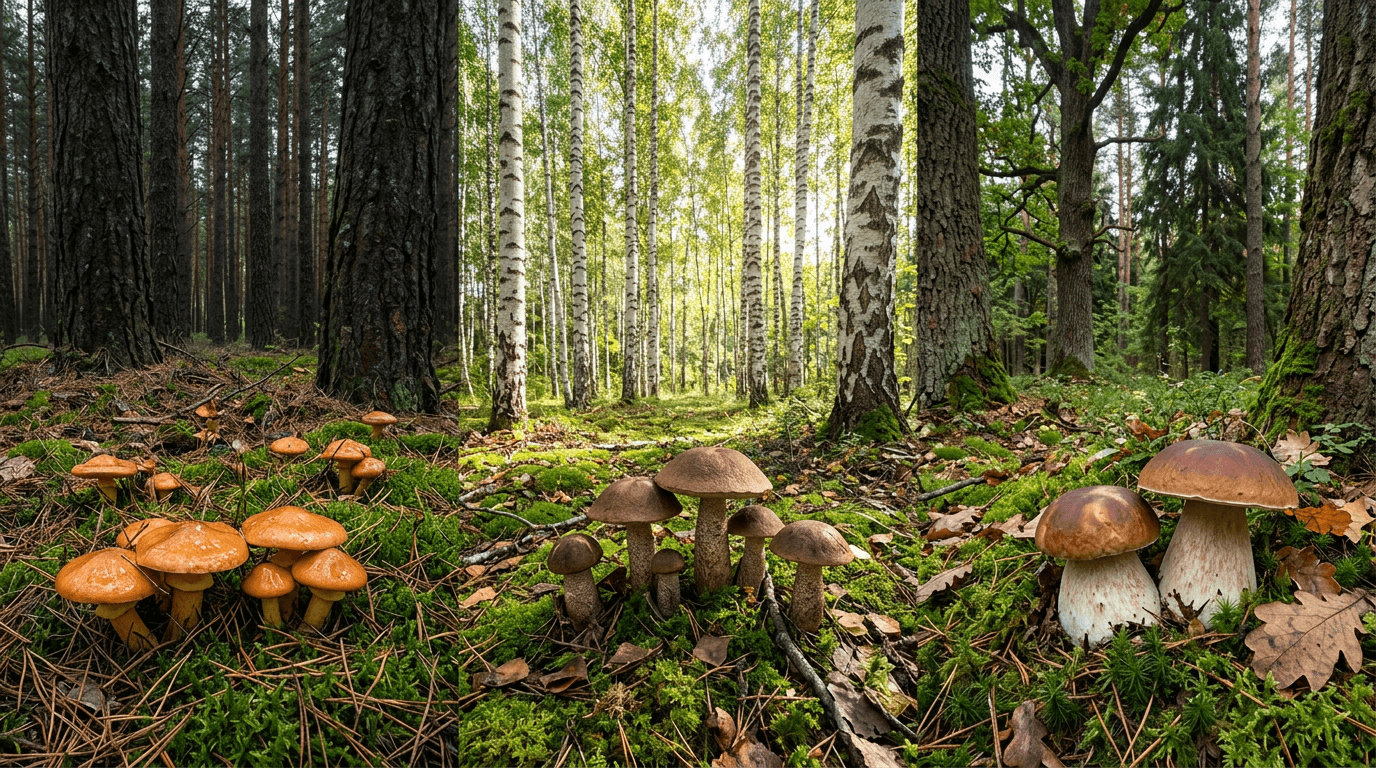
Not every forest is equally good for mushrooms — and any experienced forager will confirm it. You can wander for an hour through a beautiful pine wood without finding a single fruiting body, then turn into an unremarkable little birch grove and fill an entire basket with birch boletes in half an hour. The secret isn’t luck. The secret lies in the forest type and the trees that grow in it. Mushrooms are not random inhabitants of the forest floor. They are connected to specific tree species by invisible threads of mycelium, and this connection determines which forest the mushrooms of a given species grow in.
As described in I. I. Sidorova’s textbook “Mycology” (Moscow State University, 2020), about 90% of edible forest mushrooms are mycorrhiza-forming: they physically cannot grow without a partner tree. Understanding this simple fact transforms the whole approach to foraging. Instead of combing acres at random, the forager begins to read the forest: spots a pine and expects slippery jacks, notices a birch and looks closely for birch boletes, finds an oak edge and searches for king boletes.
In this article we’ll break down which mushrooms are characteristic of coniferous, deciduous and mixed forests, explain the science behind it (mycorrhiza — a lovely word, but what does it actually mean?), give you a mushroom-and-tree compatibility table, and explain how to find good spots by reading the microrelief. And at the end, we’ll show how technology helps you choose the right forest without leaving home.
What mycorrhiza is and why it matters
The word “mycorrhiza” translates literally from Greek as fungus-root. It is a symbiosis between a fungus’s mycelium and a tree’s roots. The fungal hyphae wrap around the fine rootlets (and sometimes penetrate the cells) and form a shared network. Through it, the tree gives the fungus carbohydrates — the products of photosynthesis, which the fungus cannot produce itself. In return, the mycelium “mines” water and mineral nutrients from the soil — above all phosphorus and nitrogen — and passes them to the tree.
According to the Forest Institute of the National Academy of Sciences of Belarus, mycorrhizal fungi increase the absorbing surface of a tree’s root system by a factor of 10–100. A tree without mycorrhiza is like a human without gut microflora: it will survive, but it will be sickly and grow poorly. This is precisely why foresters have long used mycorrhizal preparations when planting seedlings.
For the forager, this means one simple thing: no partner tree, no mushroom. The slippery jack forms ectomycorrhiza exclusively with two-needled pines. The birch bolete — only with birch. The spruce saffron milk cap — only with spruce. A study in the journal Forest Ecology and Management (2019) showed that even a small change in a forest’s species composition (for example, cutting 30% of the birches) leads to a noticeable decline in the diversity of mycorrhizal fungi within 3–5 years.
There are also “cosmopolitan” mushrooms. The king bolete, for instance, forms mycorrhiza with pine, spruce, birch and oak — hence its widespread distribution. The chanterelle is not too fussy either: it partners with spruce, pine, birch and oak. But most species are still tied to one or two tree species. And by knowing that tie, you turn a random walk in the woods into a purposeful mushroom hunt.
Coniferous forest — the realm of slippery jacks and saffron milk caps
A coniferous forest is first and foremost pine and spruce woods. The soil here is acidic (pH 3.5–5.5), covered with a thick layer of coniferous litter. Little sunlight reaches the forest floor — the dense canopy holds it back. The conditions might seem harsh. But for a whole range of species, mushrooms in coniferous forest are the most natural of habitats.
Slippery jacks are the calling card of the pine forest. The slippery jack (Suillus luteus) grows exclusively under pine. It is especially fond of young plantings: pine stands 10–30 years old with sparse undergrowth and a moss cover. Slippery jacks are among the first to appear — as early as June — and fruit in waves until October. Look for them on sandy soils, along forest roads and at woodland edges, where the soil warms up better.
Saffron milk caps are another “coniferous” mushroom. The pine saffron milk cap (Lactarius deliciosus) is found under pines on sandy and sandy-loam soils, while the spruce saffron milk cap (Lactarius deterrimus) grows under spruces, often among young spruce stands. As noted in the reference guide “Mushrooms of Belarus” (O. S. Gapienko, 2012), saffron milk caps prefer open, well-lit spots — not dark thickets, but bright clearings, edges and cuttings.
The pine king bolete (Boletus pinophilus) is a dark-capped beauty with a reddish-brown cap. It prefers old pine woods with a mossy floor. It grows in small groups, often on higher ground. Unlike its birch counterpart, the pine king bolete chooses drier and more acidic spots.
Bay boletes and man-on-horseback round out the coniferous basket. The bay bolete loves pine stands with bilberry, while the man-on-horseback (Tricholoma equestre) is one of the few that can be gathered even at the end of October, when most mushrooms have already gone. It hides in the coniferous litter, and finding it without experience is not easy. Spruce stands are also home to the slimy spike-cap — an unassuming mushroom, but edible and tasty after proper preparation.
Deciduous forest — home of birch boletes and milk caps
Deciduous forests — birch groves, oak woods, aspen stands — are a completely different world. The soil here is neutral or slightly acidic (pH 5.0–7.0), the litter is loose and rich in humus. Light penetrates the canopy better than in a spruce wood: broadleaf trees create a dynamic mosaic of light and shade. All of this forms the ideal environment for its own group of mycorrhizal fungi.
The birch bolete (Leccinum scabrum) is the classic mushroom under birch. The name speaks for itself: it won’t grow without birch. Birch boletes are found in pure birch groves, on the verges of forest roads, and in young birch stands. They love damp, slightly boggy spots — that is where the mycelium gets enough water. The season is long: from June through October, peaking in August.
The aspen bolete (Leccinum aurantiacum) is another king of the deciduous forest. Despite its name, it forms mycorrhiza not only with aspen but also with birch, poplar and willow. The aspen bolete is large, fleshy and fast-growing. Experienced foragers know: if you find one, look nearby — they often grow in “families” of 3–7. It prefers damp spots with tall grass at the boundary between forest and clearing.
Milk caps are inhabitants of birch and birch-aspen forests. The true milk cap (Lactarius resimus) forms mycorrhiza with birch and is found in pure birch groves with a litter of last year’s leaves. The aspen milk cap (Lactarius controversus) grows under aspens and poplars. Milk caps hide: you literally have to dig them out from under the layer of leaves. According to the Department of Mycology and Algology at Moscow State University, the true milk cap forms mycorrhiza only with birch on soils with a sufficient calcium content.
Woolly milk caps — both pink and white — are also “birch” mushrooms. The pink woolly milk cap (Lactarius torminosus) appears in large numbers in birch forests from late July. It is less capricious than the true milk cap and often grows in huge patches — the main thing is that there’s a birch nearby and enough moisture. In oak woods, look for the oak king bolete (Boletus reticulatus) with its pale cap and netted stem, as well as the oak bolete — a robust mushroom with a dark cap and flesh that reddens when cut.
Mixed forest — the ideal choice for the forager
If you want maximum species diversity in a single basket, head for a mixed forest. There, pine stands beside birch, spruce beside aspen, and oak turns up at the edges. Each tree has “brought along” its own set of mycorrhizal partners, and as a result, a single hectare of mixed forest can hold mushrooms that would never have ended up side by side in a pure coniferous or deciduous forest.
In ecology this is called the edge effect — at the boundary of two ecosystems, species diversity is always higher than inside either one. A study in the journal Forest Ecology and Management (2019) confirmed that in transition zones between coniferous and deciduous forest, the number of macrofungi species is 35–45% higher than in pure stands. For the forager, these boundaries are a genuine El Dorado.
The practical takeaway is simple. In a mixed forest you can find, in a single walk, slippery jacks under a pine, birch boletes near a birch, king boletes in a spruce stand and woolly milk caps at a birch edge. It’s harder to leave such a forest empty-handed — there is always at least one species for which conditions are right just now.
Especially prized are mixed forests dominated by pine and birch on moderately moist sandy soils — this is the typical landscape of central Belarus and central Russia. As specialists at the Forest Institute of the National Academy of Sciences of Belarus point out, it is precisely such forests that yield the largest harvest of edible mushrooms per hectare. People call such places “a forest made for mushrooms.”
Mushrooms and trees: a compatibility table
Below is a summary table that’s handy to save before heading into the forest. It shows which mushrooms form mycorrhiza with which trees. When you spot a particular tree species in the forest, you check the table and know exactly what to look for underfoot.
| Tree | Partner mushrooms |
|---|---|
| Pine | Slippery jacks, saffron milk caps, king bolete (pine), bay bolete, chanterelles, man-on-horseback |
| Spruce | King bolete (spruce), spruce milk cap, slimy spike-cap, chanterelles, russulas |
| Birch | Birch bolete, king bolete (birch), woolly milk cap, true milk cap, chanterelles, russulas |
| Aspen | Aspen bolete, aspen milk cap, russulas |
| Oak | King bolete (oak), bay bolete, milk-white brittlegill, oak bolete, chanterelles |
| Alder | Brown roll-rim, pink woolly milk cap, milk cap |
| Hazel | White truffle, chanterelles, russulas |
| Linden | Black milk cap, oak bolete, russulas |
* The table is compiled from the reference guide “Mushrooms of Belarus” (O. S. Gapienko, 2012) and I. I. Sidorova’s textbook “Mycology” (Moscow State University, 2020). The most common species are listed; the full range of mycorrhizal associations is considerably wider.
How to find a mushroom spot in the forest
Knowing where to look for mushrooms by forest type is only half the job. The other half is being able to read the microrelief within the forest itself. Mushrooms are distributed unevenly: some patches are literally strewn with fruiting bodies, while a hundred meters away there isn’t a single one. Here’s what to watch for.
Woodland edges and forest margins. The boundary between forest and open space is a classic mushroom spot. There’s more light here, the soil warms up better, and after rain the moisture lingers longer than in an open field. The edge effect works here too: at a woodland margin, the forest and meadow ecosystems meet, creating additional niches.
Cuttings and forest roads. Along cuttings, conditions resemble those at woodland edges: more light, more warmth. Slippery jacks, for example, are especially fond of growing along dirt forest roads in pine plantings. The verges of paths are also a good spot, especially if the path runs along the boundary of a coniferous and a deciduous area.
Moss and bilberry. A moss cover is a reliable companion of many mushrooms. Moss retains moisture, creates a stable microclimate and protects the mycelium from drying out. King boletes and chanterelles often grow in moss. Bilberry in a pine forest is another marker: if the bilberry bushes are fruiting abundantly, then conditions are right for the mycelium too.
Low rises and slopes. Mushrooms don’t like standing water. Gentle slopes and low hills in the forest provide good drainage — moisture is present, but it doesn’t pool. King boletes are often found on exactly these “knolls,” especially if they’re covered with moss. Low-lying spots with stagnant water are, conversely, the domain of only a few species (slimy spike-caps, some russulas).
Landmark trees. If you find a lone birch in the middle of a pine wood, be sure to examine a circle 5–10 meters in radius around it: birch boletes may grow there that you won’t find anywhere else in that forest. The same goes for lone pines in a deciduous forest — you may find slippery jacks beneath them. Such trees are points of anomalous diversity, and experienced foragers remember their coordinates for years.
Finding a forest with the help of technology
So, we’ve established: to find the mushrooms you want, you need to find the right forest — with the right trees, suitable soil and terrain. But how do you choose a forest in advance, especially if you’re looking for a new spot? In the past, all you could do was drive out on a hunch or rely on tips from friends.
The “Forest Search” feature in SkyForest analyzes satellite data and determines the forest type, tree species and forest cover for any point on the map. You can find a suitable forest without leaving home: you specify an area, and the system shows where there’s a pine wood, where a birch grove, and where a mixed forest with the combination of species you need. Knowing the mushroom-and-tree compatibility table, you know exactly what to look for in each particular forest.
And if you combine forest-type data with weather monitoring — precipitation, temperature, humidity — the picture becomes complete. You not only know where to go, but also when. That is exactly why we’re building SkyForest: so that every mushroom hunt ends with a full basket.
Frequently asked questions
Which forest has the most mushrooms?
The greatest variety and abundance of mushrooms is found in mixed forests. A diversity of trees creates more niches for mycorrhizal fungi. According to the Forest Institute of the National Academy of Sciences of Belarus, mushroom species diversity in mixed forests is 30–40% higher than in pure coniferous or deciduous stands.
Which mushrooms grow only in coniferous forest?
Strictly coniferous species include the slippery jack (only with pine), pine saffron milk cap, spruce saffron milk cap, slimy spike-cap and man-on-horseback. These mushrooms form mycorrhiza exclusively with conifers and are not found in pure deciduous forests.
Why do birch boletes grow specifically under birches?
The birch bolete (Leccinum scabrum) is an obligate mycorrhizal partner of birch. Its mycelium physically wraps around the birch's roots and exchanges nutrients with the tree. Without birch, the birch bolete cannot form a fruiting body — it simply has no source of carbohydrates.
Can you find king bolete in any forest?
The king bolete (Boletus edulis) is one of the most versatile mycorrhizal mushrooms. It forms a symbiosis with pine, spruce, birch, oak and beech. That is why king boletes are found in coniferous, deciduous and mixed forests alike — though in each forest type it is a distinct subspecies with minor visual differences.
How can you identify the forest type by its trees?
Coniferous forest: more than 80% of the trees are pine, spruce or fir. Deciduous: more than 80% are birch, aspen, oak, maple or linden. Mixed: neither conifers nor broadleaf trees fully dominate. The easiest cue is the forest floor: needles and cones mean coniferous, fallen leaves mean deciduous, and a mix of both means a mixed forest.
Find your mushroom forest
SkyForest determines the forest type, tree species and weather conditions for any point on the map. Choose a forest to match the mushrooms you want — and head out on your mushroom hunt with confidence.
Try SkyForest →Read also
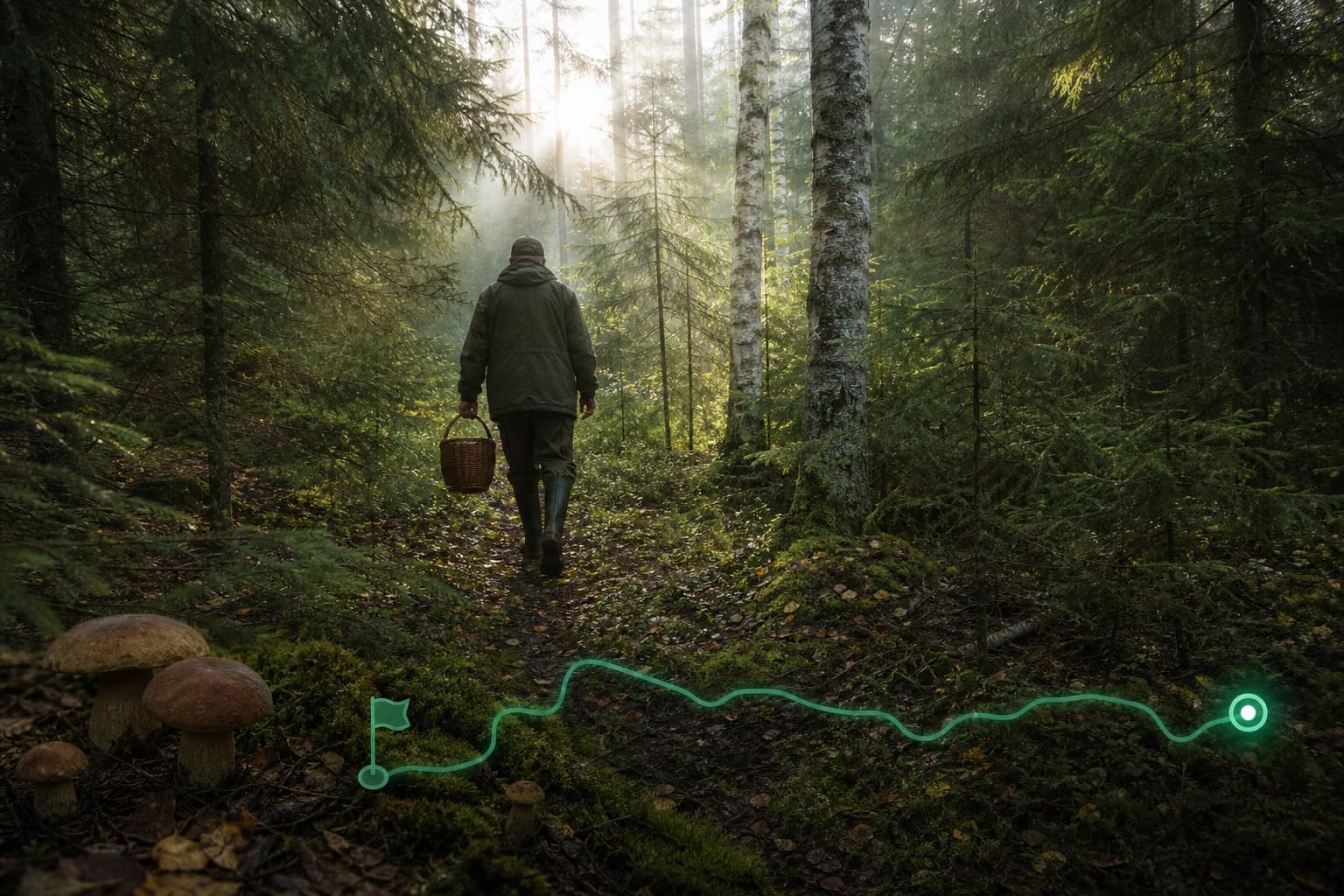
How not to get lost in the forest: the Track feature in SkyForest
Track remembers your forest entry point, draws your path on the map and points the way back — even offline.
7 min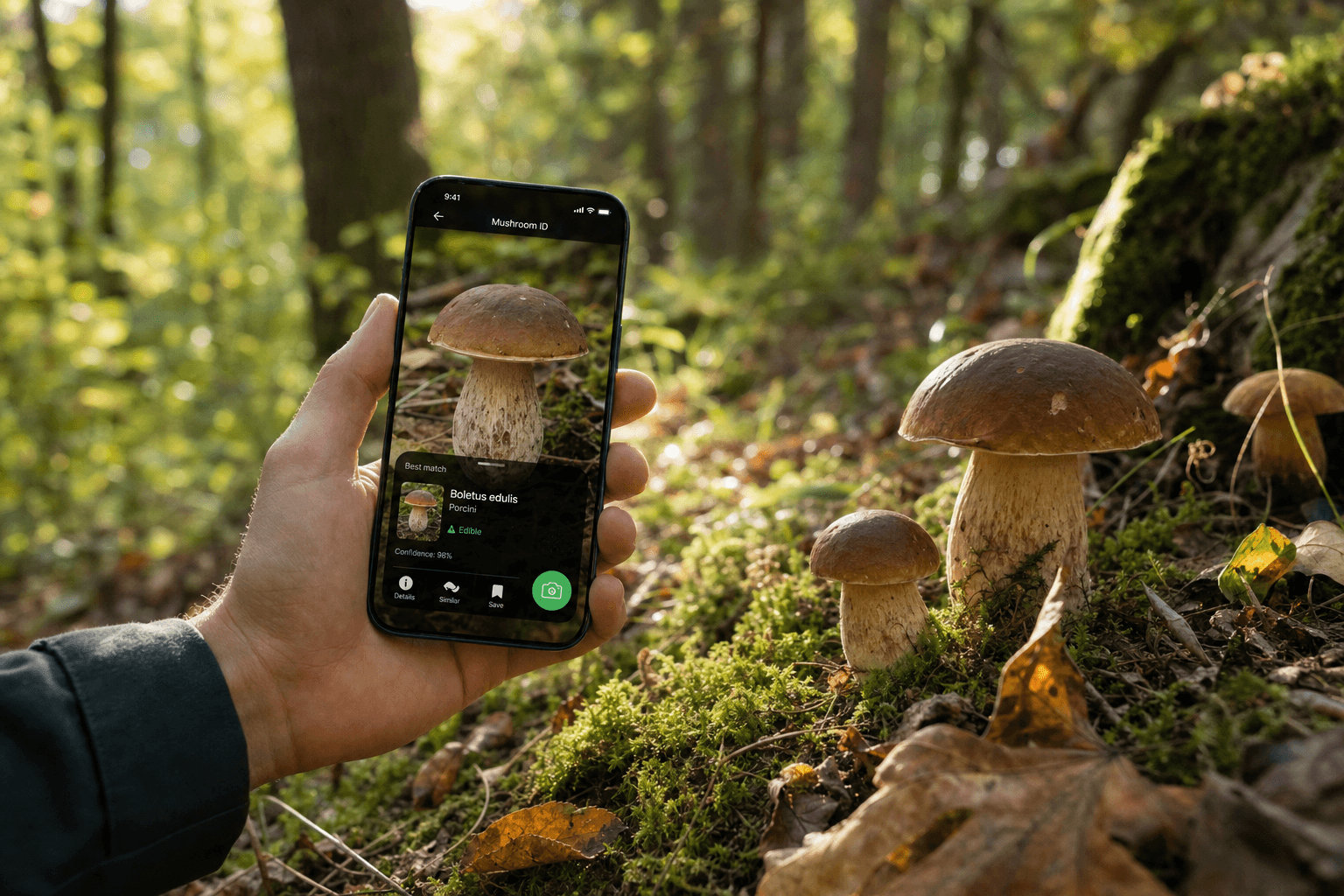
How to identify a mushroom from a photo: apps, neural networks and key features
How accurate identifiers are, what to photograph and which features to check. Plus the SkyForest identifier on Telegram.
11 min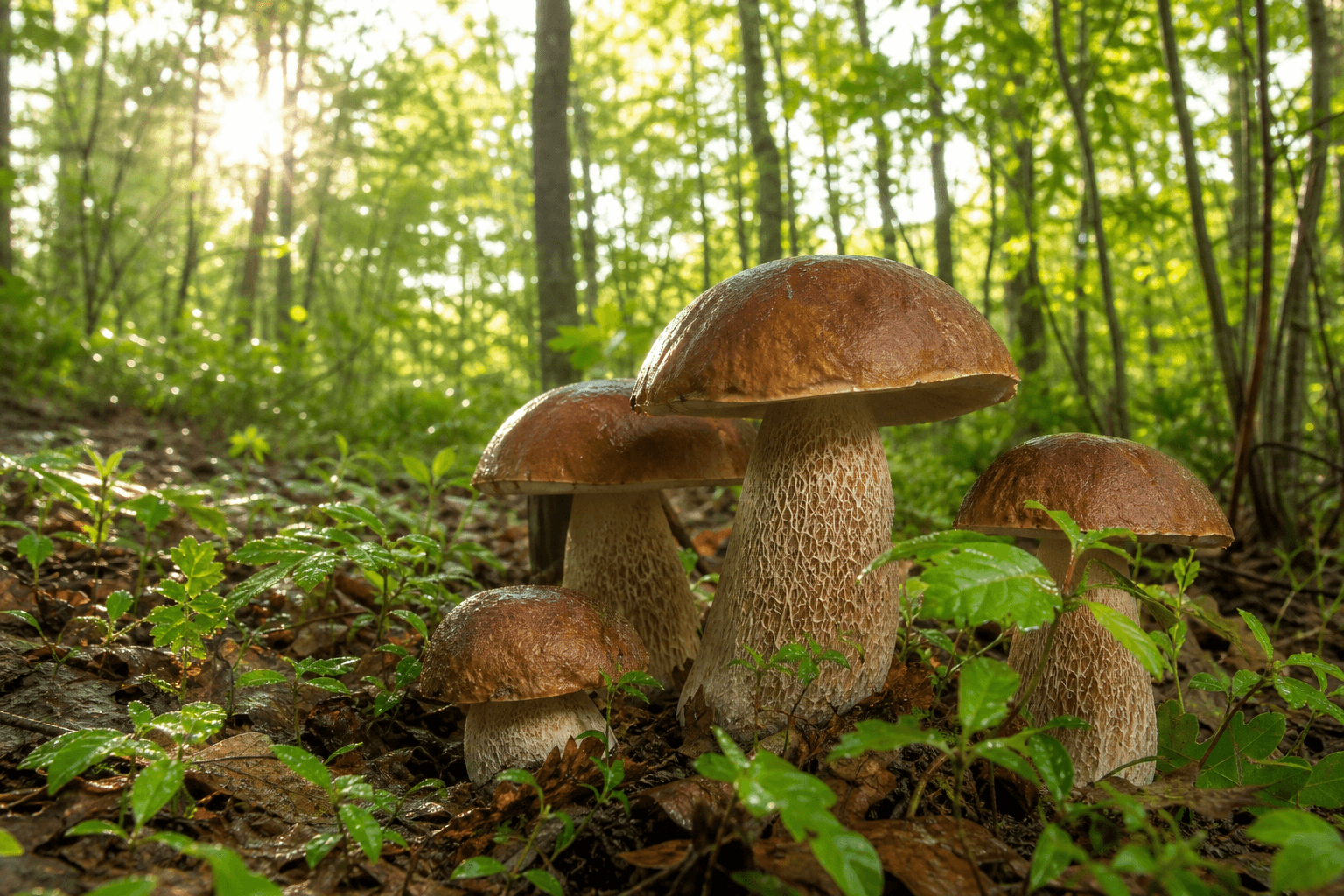
The first May porcini: where and when to find the early cep
The summer cep is the earliest porcini. Timing, locations, weather and how to tell it from look-alikes.
10 min
Weather for mushrooms: at what temperature and humidity mushrooms grow
Which weather conditions are ideal for mushroom growth. Temperature, humidity and rainfall — what matters most.
12 min
How many days after rain do mushrooms appear
The best windows after rainfall for different species. Ceps, chanterelles and honey mushrooms each have their own timing.
8 min
When it's time to head to the forest: 7 signs the mushrooms are up
Practical signs that the season has started. Soil temperature, first finds and other clues.
6 min
Where mushrooms grow in Russia and Belarus
Regions, forests and specific spots for mushroom foraging. A map of mushroom locations and planning tips.
12 min