
How to Identify a Mushroom from a Photo: Apps, Neural Networks and Key Features
Updated: June 15, 2026 · Reading time: 11 min
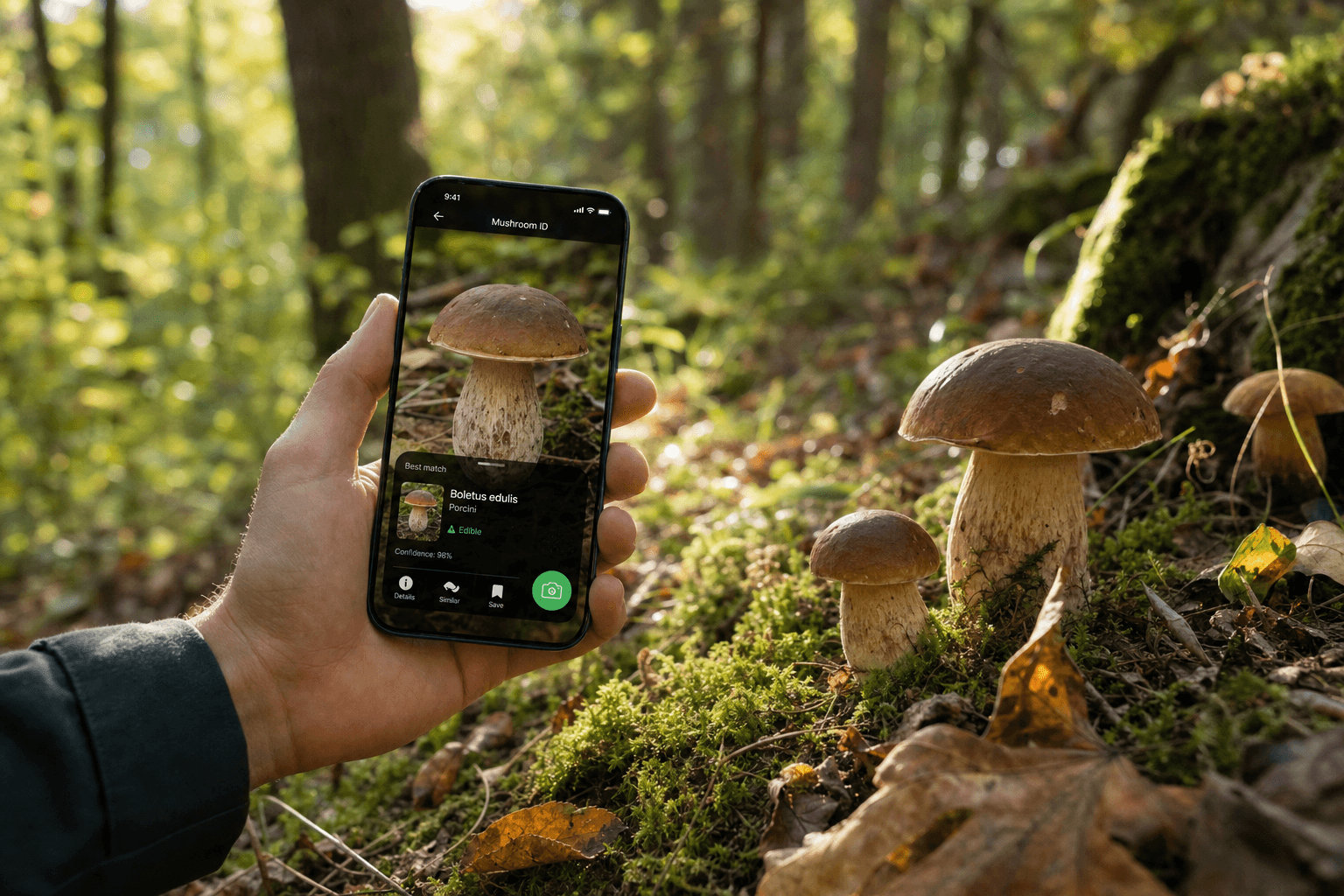
“What kind of mushroom is this?” is probably the most common question in the forest. You’ve found a beautiful, sturdy bolete — or is it an inedible lookalike? In the past, only experienced foragers and rare field guides knew the answer. Today all you need to do is take out your smartphone, photograph your find — and a couple of seconds later a neural network suggests the species. It sounds like magic, but behind this simplicity lie important nuances worth understanding before you trust the algorithm.
In this article we’ll take an honest look at how mushroom identification from a photo actually works, how accurate the popular apps really are, what and how to photograph correctly, which features you need to check by hand — and where the line lies beyond which trusting the algorithm becomes dangerous.
How a mushroom gets identified “from a photo” at all
At the core of every modern identifier is a convolutional neural network (CNN) — the same type of algorithm used in facial recognition. Simplified, the process looks like this: your photo is turned into an array of pixels, the neural network extracts visual features from it — from simple contours and textures to the complex shapes of the cap and stem — and then compares them with a trained database and returns a list of the most likely species with a match percentage.
The key word here is “likely”. The algorithm doesn’t “know” the mushroom; it only estimates how similar it is to what it saw during training. If the angle is unusual, the lighting is poor, and the species is rare, an error is almost inevitable. And the main limitation: a neural network works only with what is visible in the photo. Smell, taste, changes in the color of the flesh, the type of soil — all of this stays out of frame, even though these are often the very features that distinguish an edible mushroom from a poisonous one.
How accurate the apps are: what the research says
This is where it gets really important. App marketing promises “instant and accurate recognition,” but independent scientific tests paint a far more restrained picture.
In a study published in the journal Clinical Toxicology (PubMed 36794335), three popular apps were tested on 78 samples submitted to a toxicology center. The best of them (Picture Mushroom) identified the species correctly only 49% of the time, and poisonous mushrooms — 44%. The other two managed roughly a third of the samples.
A more recent test, described in npj Science of Food (Nature, 2026), covered more than 100 photographs of nearly 60 species in real-world conditions. The conclusion: even the best-performing tool was wrong in almost 15% of cases, and no app consistently gave a single correct answer.
| App | Accuracy (all species) | Poisonous species |
|---|---|---|
| Picture Mushroom | 49% | 44% |
| Mushroom Identificator | 35% | 30% |
| iNaturalist | 35% | 40% |
According to the developers of the “Gribok” app, its database contains over 12,000 species, but reliability above 80% is claimed for only about 1,700 of them. In other words: neural networks do a decent job with common, easily recognizable mushrooms, but they easily make mistakes on rare and “disputed” species.
Psychologists call this the trap of automation bias: people tend to overestimate a machine’s decisions. The app delivered its answer in a confident tone — and you want to believe it. But with mushrooms, the cost of an error is far too high.
Anatomy of a mushroom: what exactly to photograph
The main cause of errors is a photo of the cap from above only. From the cap alone, even an expert mycologist rarely identifies the species. For both the neural network and you to draw a conclusion, you need to capture all the key parts:
- Cap from above: shape, color, surface texture (smooth, scaly, slimy).
- Underside of the cap: gills or tubes (pores) — these are different groups of mushrooms. Take a close-up.
- The whole stem: color, shape, the presence of a net or scales, and whether there is a ring (skirt).
- Base of the stem: carefully twist out the entire mushroom — there may be a volva (sac) at the base, characteristic of the deadly poisonous amanitas.
- A cut through the flesh: the color at the cut and how it changes (turns blue, turns red, stays white).
- Surroundings: the type of forest and the nearby tree — many mushrooms form mycorrhiza with strictly specific tree species.
How to take the photo correctly: a checklist
- Shoot in daylight, without flash, in focus.
- Take 3–5 shots from different angles, not just one.
- Place a ruler or coin next to it for scale.
- Clean soil and leaves off the cap and stem, but do not damage the mushroom.
- Shoot against a neutral background (your palm, a sheet of paper) if the background is too busy.
The SkyForest mushroom identifier in Telegram
So you don’t have to install a separate app, we built a free identifier right inside Telegram. You send the bot a photo of a mushroom — it recognizes the most likely species and sends you a summary. A handy way to check your find without leaving the messenger.
How it works
- 3 checks free — for every new user.
- After that, 1 token = 1 identification. Tokens are purchased on the SkyForest website.
- In your account you transfer some of your tokens to the bot’s balance — and identify mushrooms from photos.
Important: our bot, like any other identifier, is a helper, not an expert. Use it to narrow down the possibilities and learn more about mushrooms, but always verify the final decision against the features.
Safety rules: when you can’t trust it
No app and no bot should be the sole basis for putting a mushroom in your basket, let alone in the frying pan. Remember a few rules:
- When in doubt, leave it out. This is the forager’s golden rule, older than any neural network.
- Be especially careful with gilled mushrooms: they include the most dangerous lookalikes (the death cap, the amanitas).
- Check the volva and ring — they aren’t visible in a top-down photo, yet they are exactly what gives away deadly poisonous species.
- When in doubt, show your find to an experienced forager or mycologist.
- At the first signs of poisoning (nausea, abdominal pain, weakness) — see a doctor immediately, without waiting for things to get worse.
Bottom line
Identifying mushrooms from photos is a great tool for learning, broadening your horizons and quickly checking your finds. Modern neural networks recognize common species fairly well, but make mistakes on rare and dangerous ones. Take high-quality photos from several angles, check the key features by hand and remember: the algorithm is a helper, and responsibility for the decision always rests with you. Use the SkyForest identifier as a convenient hint — but keep the final check for yourself.
Frequently asked questions
Can you accurately identify a mushroom from a photo?
A photo is a helpful aid, but not a guarantee. Independent studies show that even the best apps identify a mushroom correctly only about half the time, and poisonous species even less often. That is why the result of a photo-based identification should always be double-checked against key features, and you should never eat an unfamiliar mushroom while relying on an app alone.
How should you take a photo to make identification more accurate?
Photograph the mushroom from several angles: the cap from above, the underside of the cap (gills or pores), the entire stem and, crucially, its base, as well as a cut through the flesh. Shoot in daylight, in focus, and place a ruler or coin next to it for scale. The more details are visible, the higher the chance of correct identification.
Which mushroom features should you check by hand?
The type of hymenophore (gills or pores), the presence of a ring on the stem and a volva (sac) at the base, the color of the flesh when cut and how it changes, the smell, the type of forest and the partner tree. Many deadly species (for example, the death cap) give themselves away precisely by the volva and ring, details that are not visible in a top-down photo.
How does the SkyForest mushroom identifier in Telegram work?
You send the bot a photo of a mushroom, and the neural network suggests the most likely species. The first 3 identifications are free. After that, each identification costs 1 token; tokens are purchased on the SkyForest website and transferred to the bot's balance in your account.
Should you eat a mushroom if the app identified it as edible?
No. No app and no neural network gives a hundred percent guarantee. There have been cases of poisoning after an incorrect identification. If you have even the slightest doubt, do not pick the mushroom. If you suspect poisoning, seek medical help immediately.
Read also
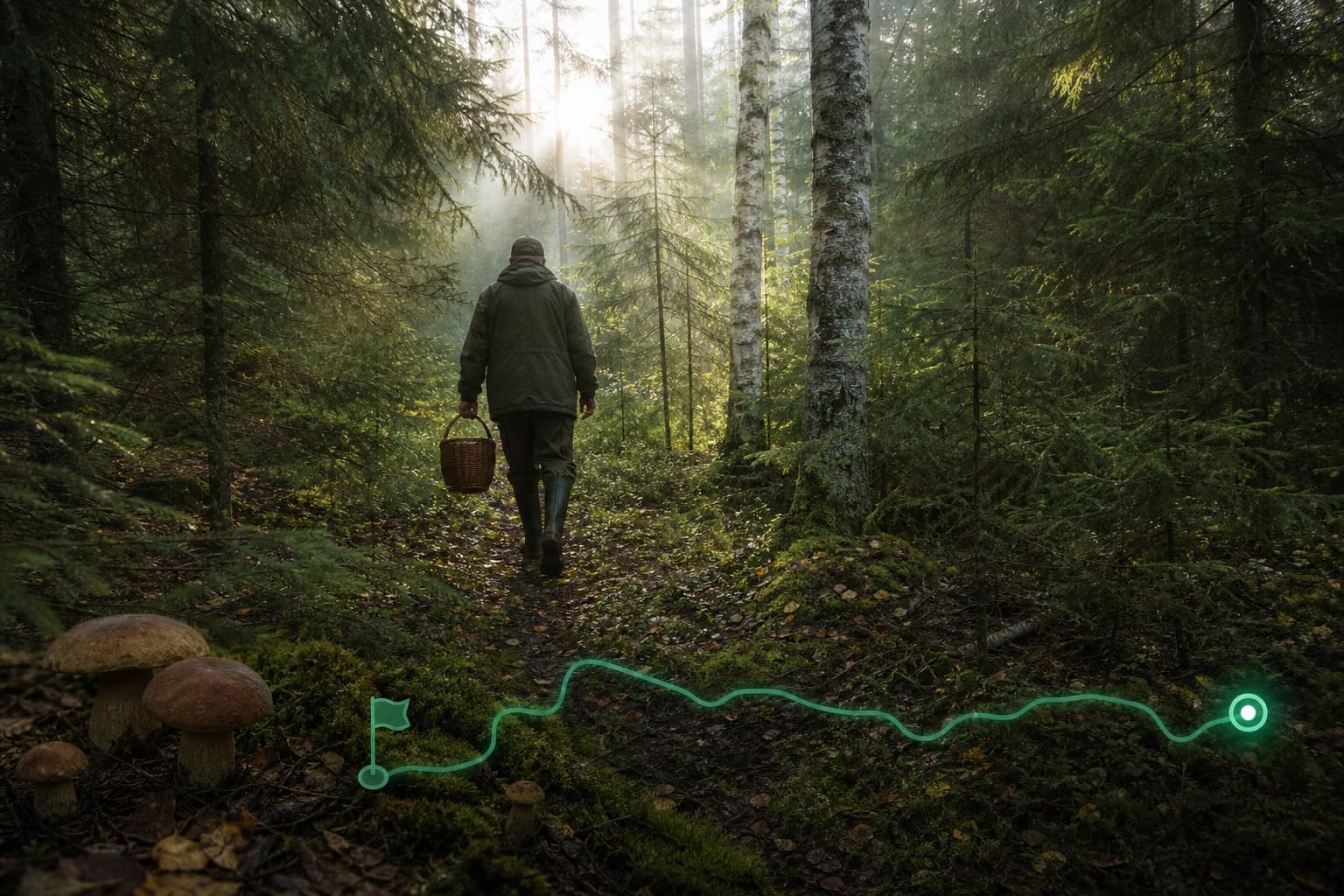
How not to get lost in the forest: the Track feature in SkyForest
Track remembers your forest entry point, draws your path on the map and points the way back — even offline.
7 min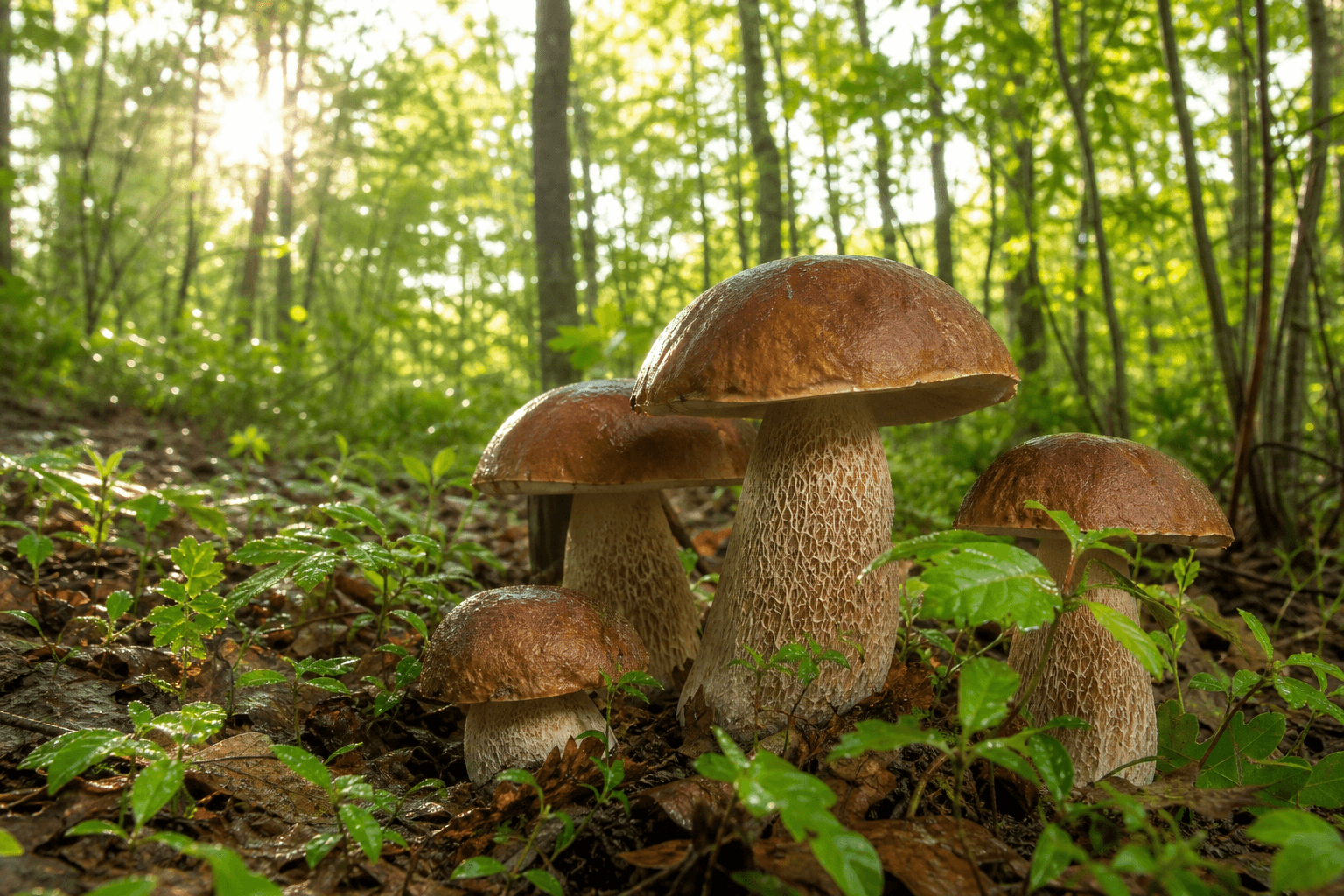
The first May porcini: where and when to find the early cep
The summer cep is the earliest porcini. Timing, locations, weather and how to tell it from look-alikes.
10 min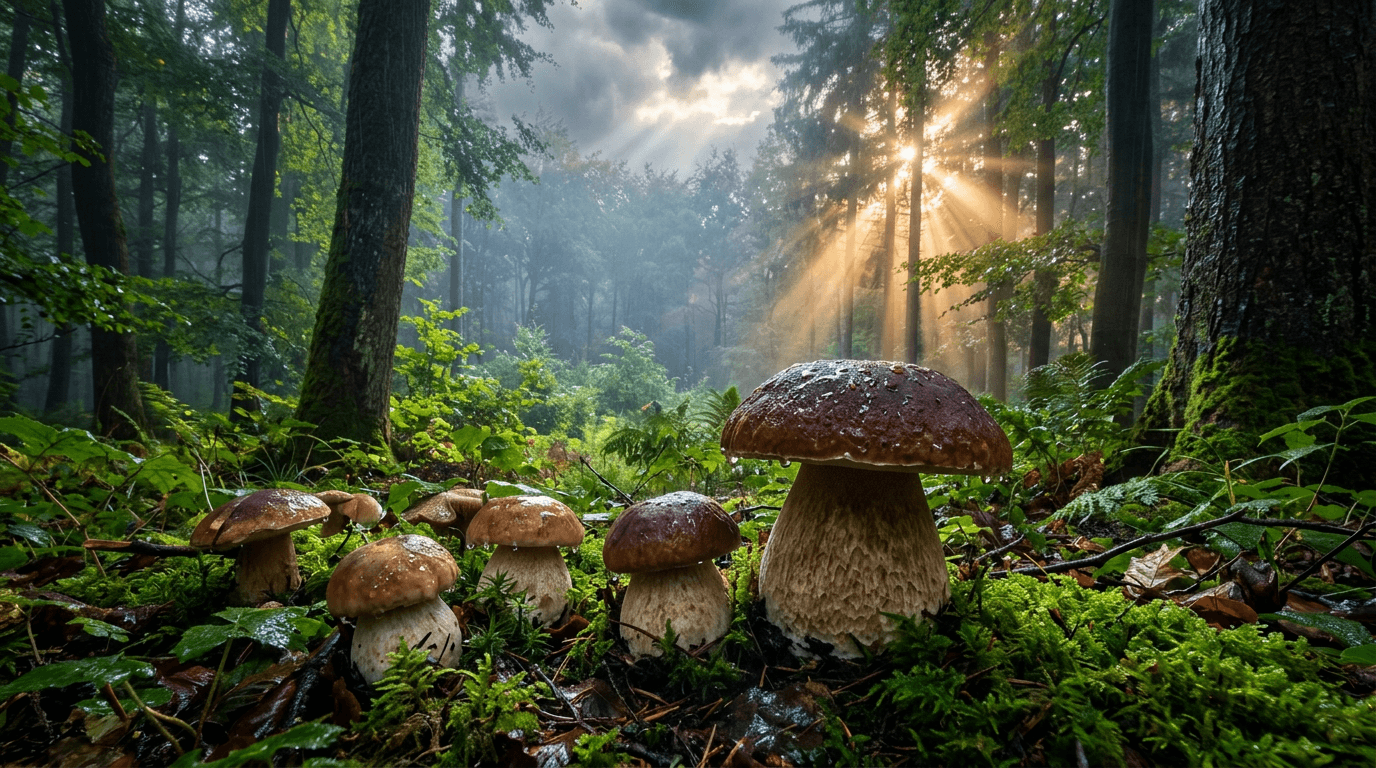
Weather for mushrooms: at what temperature and humidity mushrooms grow
Which weather conditions are ideal for mushroom growth. Temperature, humidity and rainfall — what matters most.
12 min
How many days after rain do mushrooms appear
The best windows after rainfall for different species. Ceps, chanterelles and honey mushrooms each have their own timing.
8 min
When it's time to head to the forest: 7 signs the mushrooms are up
Practical signs that the season has started. Soil temperature, first finds and other clues.
6 min
Which forest to search for mushrooms: coniferous, deciduous or mixed
Which mushrooms grow where: ceps in pine forests, birch boletes near birches. A guide to forest types.
10 min
Where mushrooms grow in Russia and Belarus
Regions, forests and specific spots for mushroom foraging. A map of mushroom locations and planning tips.
12 minIdentify mushrooms and find the best days to forage
SkyForest tells you when the weather is perfect for the quiet hunt, and the Telegram bot helps you recognize your find from a photo. Registration is free.
Try SkyForest