
Where Mushrooms Grow in Russia and Belarus: A Complete Guide to Species and Locations
Updated: September 20, 2025 · 12 min read
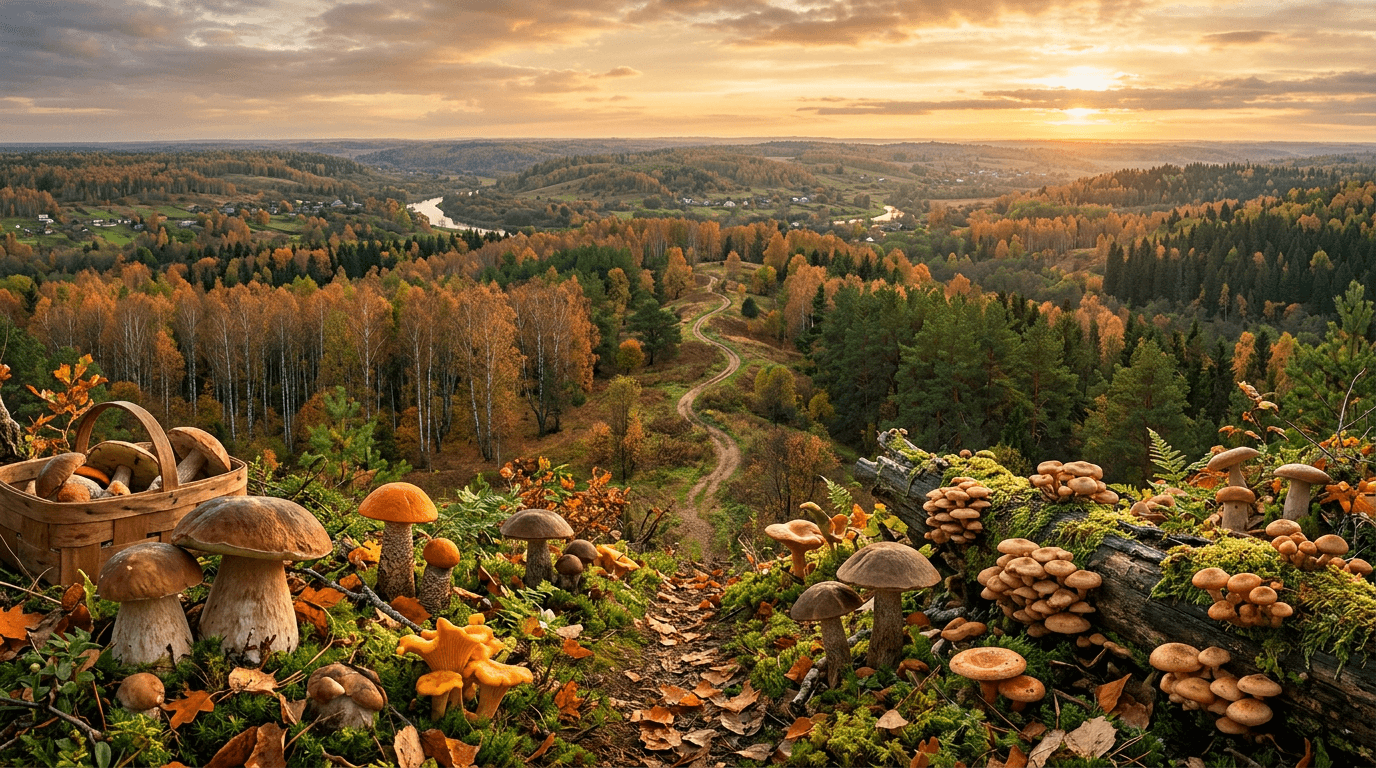
Every forager has a cherished spot. Some return year after year to the same spruce grove near Barysaw and come back every August with a basket full of porcini. Others stumbled on a glade of chanterelles in a forest outside Moscow and guard the coordinates like a state secret. And some are still searching — scrolling through forums, quizzing friends, driving out on a hunch, and coming home with an empty basket more often than a full one.
The truth is that mushroom spots are neither magic nor luck. Behind every productive forest lies a specific combination of factors: soil type, tree species, terrain, humidity, and rainfall history. According to data from the Institute of Botany of the National Academy of Sciences of Belarus, the mix of mushroom species is 70% determined by the composition of the tree stand, while the yield in any given year comes down to the weather of the previous two or three weeks.
In this guide, we’ll explore where mushrooms grow in Russia and Belarus — from general principles to specific regions and species. We’ll cover which forests to search for porcini, where to go for chanterelles, and where to gather milk caps for salting. And at the end, we’ll show you how to save and organize your own mushroom grounds so that every season is a good one.
Where mushrooms grow: general rules
Before we dive into geography, it’s worth remembering a few universal patterns. They hold true near Minsk, in the Urals, and in the Karelian taiga alike — because they’re tied to the biology of mushrooms, not to administrative borders.
Forest edges and boundaries. Mycelium develops most actively where open space meets the forest. There’s more light along the edges and the soil warms up better, yet the moisture of the forest floor is preserved. That’s exactly why seasoned foragers begin their rounds not deep in the woods but at the margins — and often find the largest specimens right there.
Glades and clearings. Forest glades, power-line clearings, and firebreaks are all equivalents of forest edges inside the woods. Mushrooms love such places for their combination of light and moisture. According to observations by Belarusian mycologists, the density of fruiting bodies in clearings within mixed forests is two to three times higher than deep in the interior.
Trails and forest roads. Mushrooms turn up more often along well-worn paths — and that’s no coincidence. The slight compaction of the soil beneath a trail creates a barrier for water: it accumulates along the edges, giving the mycelium extra moisture. Besides, paths usually run through the most convenient parts of the terrain — neither too wet nor too dry.
Zones of moderate humidity. Mycelium dislikes extremes. In waterlogged lowlands the mycelium suffocates from excess water, while on dry sandy mounds it lacks moisture. The ideal areas are gentle slopes with a mossy floor, the banks of forest streams (but above the flood line), and small rises surrounded by damp forest.
Partner trees. Most prized edible mushrooms are mycorrhizal — that is, they form a symbiosis with the roots of trees. The porcini “befriends” pine, spruce, and birch; the birch bolete pairs with birch; the aspen bolete with aspen and birch; and the slippery jack with pine. Knowing these associations, you can predict which mushrooms grow in a given spot from the mix of trees — even if it’s your first time in that forest.
Mushroom regions of Russia
Russia is one of the most mushroom-rich countries in the world. According to Rosstat, the annual harvest of wild mushrooms exceeds 100,000 tonnes, while the actual amount gathered by the population (including unrecorded picking) is estimated at 500,000–600,000 tonnes. But mushroom spots in Russia are distributed unevenly — let’s look at the main regions.
The Moscow Region
The Moscow Region is arguably the most talked-about mushroom region in the country. Despite dense development and heavy human pressure, excellent mushroom grounds have survived here. The north of the region (the Dmitrov and Taldom districts) is famous for porcini and aspen boletes in mixed forests. The west (the Ruza and Mozhaysk districts) is old spruce woodland with porcini and bay boletes. The south and southeast (the Serpukhov and Kolomna districts) are good for chanterelles and slippery jacks in young pine stands. The best months are August and September, when the average daily temperature holds around +15 to +18°C.
The Leningrad Region
The forests of the Leningrad Region are considered among the richest in European Russia. A humid climate, an abundance of coniferous and mixed forests, and boggy lowlands all create ideal conditions. The Vyborg district is renowned for porcini and chanterelles. The Priozersk and Vsevolozhsk districts are great places for aspen and birch boletes. The season here starts a little later than in the Moscow area (late July) and lasts until mid-October thanks to the humid Baltic air.
Karelia
Karelia is a paradise for lovers of mushroom foraging who aren’t put off by remoteness. Vast forests, minimal competition from other foragers, and pristine nature. The pine forests on rocky ground yield top-grade porcini, the birch groves offer birch boletes and woolly milk caps, and the spruce woods produce milk caps and saffron milk caps. The mushroom season is short but intense: from early August to late September. The key species are the porcini, aspen bolete, chanterelle, and true milk cap.
The Urals
The Ural forests are an underrated mushroom region. The Sverdlovsk and Chelyabinsk regions offer the forager both southern-taiga conifers with porcini and saffron milk caps, and the mixed foothill forests with the richest species diversity. The forests around Sysert, Nizhny Tagil, and Zlatoust are especially good. On the western slope of the Urals the humidity is higher, and the mushroom season starts earlier (mid-July). On the eastern slope the climate is more continental, but in return the autumn season (September) often produces record harvests of honey mushrooms.
Siberia
Western Siberia (the Novosibirsk, Tomsk, and Omsk regions) is a land of cedar forests, birch groves, and endless taiga. Mushrooms grow here on an industrial scale: porcini, slippery jacks, milk caps, saffron milk caps. In terms of harvest volume, the Tomsk Region ranks among the top three in Russia. The season is shifted a couple of weeks later than in central Russia — the main flush comes at the end of August and in September. A hallmark of Siberian forests is the abundance of milk caps, which are traditionally salted here by the barrel.
Krasnodar Krai
Southern Russia is an atypical mushroom region, but one with its own character. In the foothills of the Caucasus (the Apsheronsk and Mostovskoy districts) grow chestnut and beech forests with a unique set of mushrooms: Caesar’s mushroom, the reticulated porcini, and various bolete species. The season is drawn out: spring mushrooms (morels, false morels) appear as early as March, and the autumn harvest lasts until December. The humid subtropics of the Black Sea coast produce mushrooms almost year-round, though the species mix here differs greatly from what’s familiar in central Russia.
Mushroom spots of Belarus
Belarus is a compact but incredibly mushroom-rich country. Forests cover roughly 40% of its territory, predominantly mixed and coniferous. According to the Institute of Botany of the National Academy of Sciences of Belarus, more than 1,500 species of macromycetes have been recorded in the country, of which about 200 are edible. Let’s look at mushroom spots in Belarus region by region.
The Minsk Region
The most accessible for foragers from the capital. The Lahoysk district is a classic mushroom spot with pine forests and mixed woodland: porcini, aspen boletes, chanterelles. The Barysaw district is famous for its spruce woods, where in August and September you can gather porcini and milk caps. The Stowbtsy district (Naliboki Forest) is the largest woodland in Belarus and a true mushroom mecca: you’ll find practically the whole “gentleman’s set” here — from porcini to saffron milk caps.
The Vitebsk Region
Northern Belarus is one of the best mushroom regions in the country. The Lepel, Rossony, and Haradok districts are old forests with minimal economic activity. There’s an abundance of porcini, aspen boletes, and saffron milk caps here. The lake district of the Vitebsk area creates a special microclimate: the high humidity from the bodies of water sustains the mycelium even in dry years. The season runs from late June to October.
The Brest Region
The region’s crown jewel is Belovezhskaya Pushcha. A relict forest with 800-year-old oaks and unique biodiversity. According to the Red Book of the Republic of Belarus, dozens of rare mushroom species grow in the Pushcha, including the hen-of-the-woods (maitake) and the wood cauliflower. Mushroom picking in the Pushcha is restricted, but the surrounding forests of the Kamyanets and Pruzhany districts offer excellent foraging for porcini, slippery jacks, and honey mushrooms.
The Gomel Region
Southeastern Belarus features vast pine forests on the sandy soils of Polesia. This is the realm of slippery jacks, bay boletes, and gypsy mushrooms. The Mazyr and Rechytsa districts are good for porcini in pine-birch forests. The season starts earlier than in the north of the country (as early as June), thanks to the warmer climate. It’s important to note: part of the Gomel region’s forests fall within the zone affected by the aftermath of the Chernobyl disaster — picking mushrooms in those areas is not allowed.
The Grodno Region
Western Belarus, with its mild, humid climate. The Lida, Navahrudak, and Shchuchyn districts are mixed forests with oak, hornbeam, and spruce. Species diversity here is at its highest: porcini, birch boletes, chanterelles, milk caps. The Augustów Canal and its surrounding forests are a popular place for combining leisure with mushroom foraging.
The Mogilev Region
The central part of Belarus. The Klichaw, Kruhlaye, and Bykhaw districts are good mushroom spots dominated by pine and mixed forests. Aspen boletes, birch boletes, and slippery jacks make up the core “assortment.” There’s less competition than in the Minsk Region, at comparable forest quality.
Where to look for specific mushroom species
If you’re heading into the forest for a particular mushroom, it helps to know its “preferences” — the type of forest, its partner trees, and the character of the forest floor. Below is a brief guide to the most popular species.
| Mushroom species | Where to look | Partner trees | Season |
|---|---|---|---|
| Porcini | Pine forests, spruce woods, mixed forests with birch | Pine, spruce, birch, oak | July — September |
| Birch bolete | Birch groves, edges of mixed forests | Birch | June — October |
| Chanterelles | Mossy spruce woods, mixed forests, along trails | Spruce, pine, birch, oak | June — October |
| Honey mushrooms | Stumps, deadwood, weakened trees, clear-cuts | Any deciduous and coniferous | September — November |
| Slippery jacks | Young pine stands, forest plantations, edges | Pine, spruce | June — October |
| Milk caps | Birch groves, mixed forests, damp lowlands | Birch, spruce | July — October |
| Saffron milk caps | Young spruce and pine stands, forest glades | Spruce, pine | August — October |
Porcini (king bolete)
The king of foraging prefers mature forests with a well-developed mossy floor. In Russia, the best porcini grounds are the pine forests of the Moscow area, the spruce woods of the Leningrad Region, and the mixed forests of Karelia. In Belarus, they’re the Lahoysk and Barysaw districts of the Minsk Region and the Lepel district of the Vitebsk Region. Look for porcini on “mossy carpets” — a sure sign that the microclimate is right. Porcini often grow in “rings” or “trails” tied to the root system of their partner tree: once you find one, circle the tree at a radius of 3–5 metres.
Birch bolete
One of the most “democratic” mushrooms — it turns up anywhere there are birches. The edges of birch groves, young birch stands, the shoulders of forest roads. The birch bolete isn’t as fussy about moisture as the porcini, and it appears earlier — as early as June. In Belarus and central Russia it’s one of the most common mushrooms. A tip: don’t overlook urban forest parks — the birch bolete grows perfectly well even in suburban woods.
Chanterelles
The chanterelle is an indicator of a healthy forest. It doesn’t tolerate heavy pollution and is almost never worm-eaten thanks to chinomannose. Look for chanterelles in mossy spruce woods and mixed forests, along trails, and on the slopes of forest ravines. In Belarus they’re everywhere, especially in the Vitebsk and Grodno regions. In Russia — the Leningrad Region, the Moscow area, and Karelia. Chanterelles grow in “patches”: if you find one, stop where you are and carefully scan the area around you for 10–15 metres. There are probably dozens of them.
Honey mushrooms
Honey mushrooms are the only one of the “top-tier” mushrooms that grow not on the ground but on wood. Look for them on stumps, deadwood, and at the base of weakened trees. Old clear-cuts and windthrows are their favourite spots. In Belarus and Russia they occur everywhere, but they’re especially plentiful in old deciduous forests with a lot of dead wood. Autumn honey mushrooms appear with the cold snaps, often in a “burst” — several kilograms can grow on a familiar stump in a single morning.
Slippery jacks
The slippery jack is a faithful companion of the pine. Young pine plantations (15–30 years old), the edges of pine forests, and forest glades with scattered pines are classic slippery jack spots. In Belarus there are plenty of them in the Gomel and Minsk regions; in Russia — in the Moscow area (the Ruza and Klin districts), in the Urals, and in Western Siberia. Slippery jacks respond to rain faster than any other mushroom — they appear just 2–3 days after a good, warm downpour.
Milk caps and saffron milk caps
Milk caps are mushrooms for the patient. They hide beneath a layer of leaves and needles, often invisible to the naked eye. Look for them in birch groves and mixed forests, in damp areas with a thick forest floor. Saffron milk caps, on the other hand, favour young spruce and pine stands with a grassy floor. Both species are traditional “salting” mushrooms, especially popular in Siberia and the Urals, where they’re preserved in large quantities. In Belarus, saffron milk caps are good in the Vitebsk Region and in the north of the Minsk Region.
How to save and share your mushroom spots
Every experienced forager builds up a “database” of proven spots. Some mark them on a GPS, some draw them on a paper map, and some simply remember “the second turn after the bridge, then two hundred metres along the stream.” The problem is that such notes are easily lost, and it’s impossible to tie weather conditions to them.
With SkyForest you can save the coordinates of all your mushroom spots. Each location is pinned to the map — you can see the forest type, the tree species, and the weather history. The service remembers the conditions under which you made your best hauls and notifies you when the weather pattern repeats.
And on the marketplace, experienced foragers sell proven locations complete with weather patterns — a genuine mushroom map from the community. You get not just a point on a map but the full context: which mushrooms, in what kind of forest, in what weather, and in which months. It saves you dozens of hours of searching and hundreds of kilometres of fruitless trips.
Safety rules for picking mushrooms
Foraging is a pleasure, but also a responsibility. Here are a few rules that every mushroom picker should follow, regardless of experience.
Don’t pick unfamiliar mushrooms. This is rule number one. The death cap and some species of fly agaric are deadly poisonous, and even an experienced forager can confuse them with a button mushroom or a russula. If you’re in doubt, leave the mushroom in the forest. According to the Belarusian Ministry of Health, 50–100 cases of mushroom poisoning are recorded in Belarus every year.
Don’t gather mushrooms near roads and industrial areas. Mycelium actively accumulates heavy metals, radionuclides, and other pollutants from the soil. The minimum distance from a highway is 200–300 metres, and from industrial facilities at least 1 km.
Tell loved ones your route. It’s easier to get lost in the forest than it seems — especially in an unfamiliar place. Let someone know where you’re going and when you plan to return. Take a charged phone, a compass, or a GPS navigator. In season, carry a whistle — three short blasts is the universal distress signal.
Don’t damage the mycelium. Cut or gently twist the mushroom out at the base of the stem. Don’t tear up the moss and forest floor in search of small mushrooms — let them grow. The mycelium you preserve today will give you a harvest next season too.
Frequently asked questions
Which regions of Russia have the most mushrooms?
The leaders in mushroom resources are the Leningrad Region, the Moscow area, Karelia, the Urals (Sverdlovsk and Chelyabinsk regions), and southern Siberia (Novosibirsk and Tomsk regions). These regions combine vast forests, a temperate climate, and ample rainfall.
Where are the best mushroom spots in Belarus?
The most productive regions are the Vitebsk and Minsk areas with their mixed forests. The forests of the Lahoysk, Barysaw, and Lepel districts deliver excellent results. Belovezhskaya Pushcha (Brest Region) is a unique place with rare species, but mushroom picking there is restricted.
When is the best time to go mushroom hunting?
The peak of the mushroom season in central Russia and Belarus runs from mid-August to late September. That said, the first mushrooms (slippery jacks, birch boletes) appear as early as June, while late species (honey mushrooms, tricholoma) fruit until November. The exact timing depends on the weather.
How can I find a mushroom spot as a beginner?
Start with the mixed forests near your town — that's where species diversity is highest. Look for forest edges, glades, and stream banks. Pay attention to moss, birches, and young pines. And on SkyForest, you can buy proven locations complete with weather patterns from experienced foragers.
Can you pick mushrooms in nature reserves?
In strict nature reserves, mushroom picking is generally prohibited. In national parks and wildlife sanctuaries it's allowed with restrictions (often for personal use only). Always check the rules for the specific area. In Belarus, for example, picking in Belovezhskaya Pushcha is only permitted in designated recreational zones.
Read also
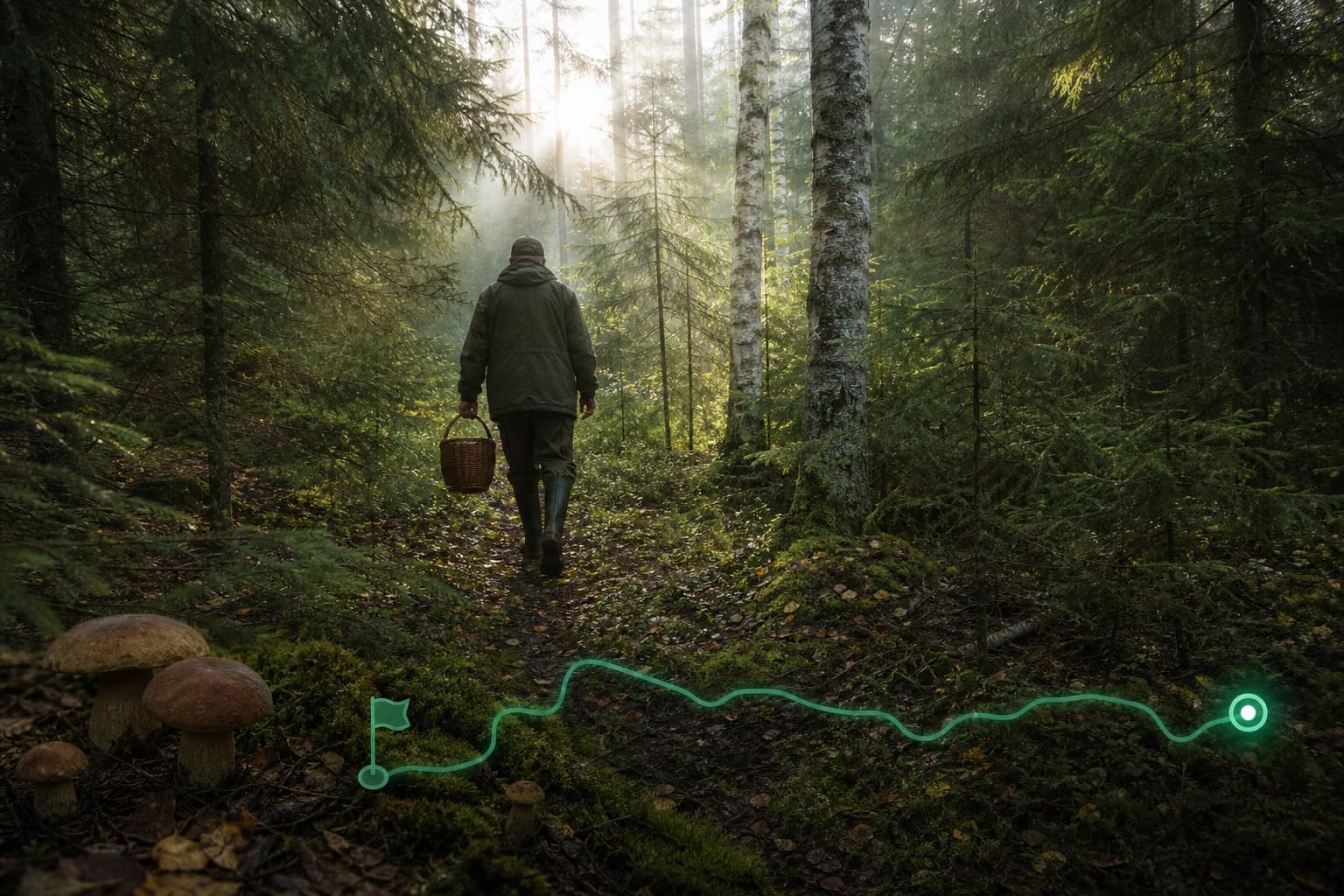
How not to get lost in the forest: the Track feature in SkyForest
Track remembers your forest entry point, draws your path on the map and points the way back — even offline.
7 min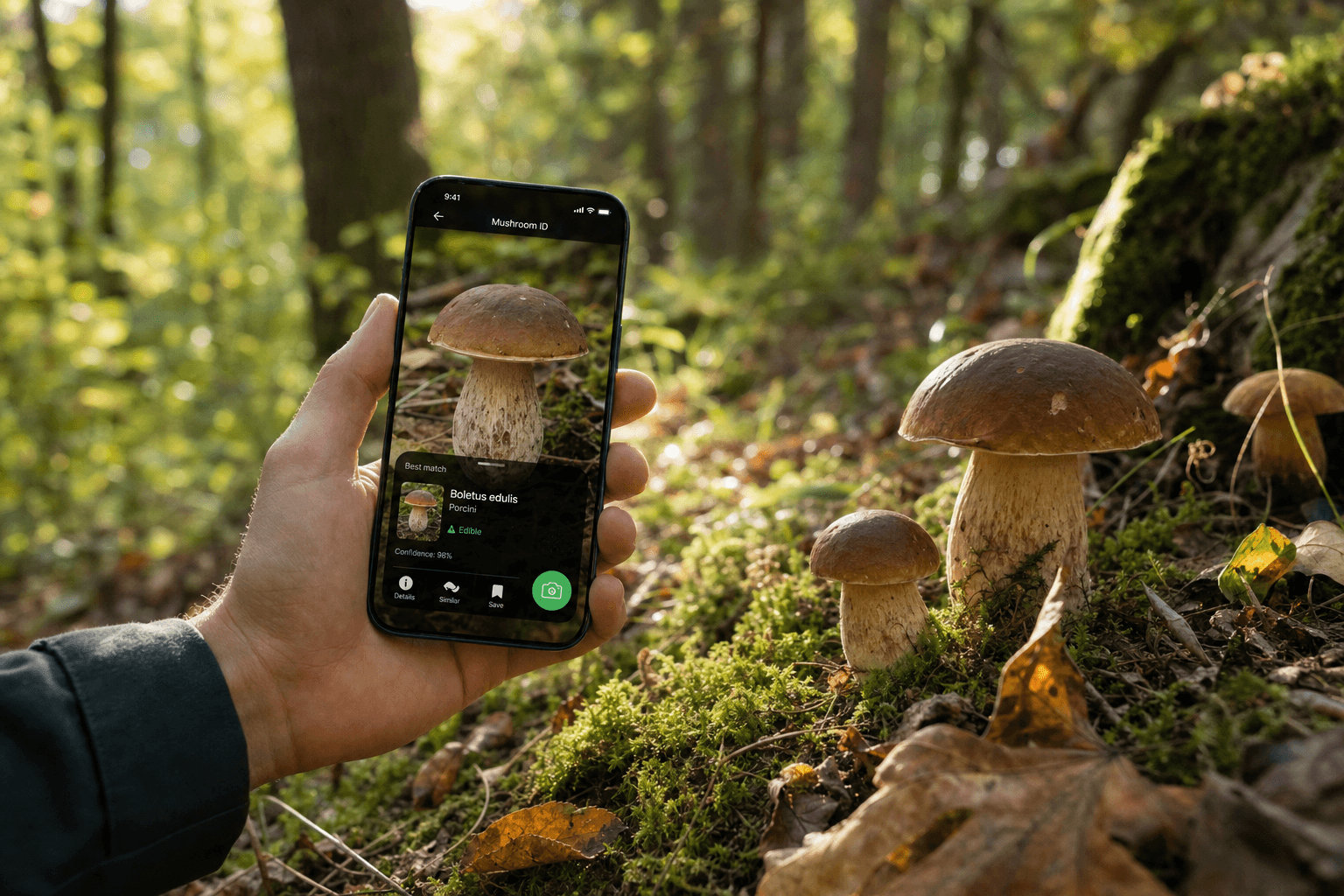
How to identify a mushroom from a photo: apps, neural networks and key features
How accurate identifiers are, what to photograph and which features to check. Plus the SkyForest identifier on Telegram.
11 min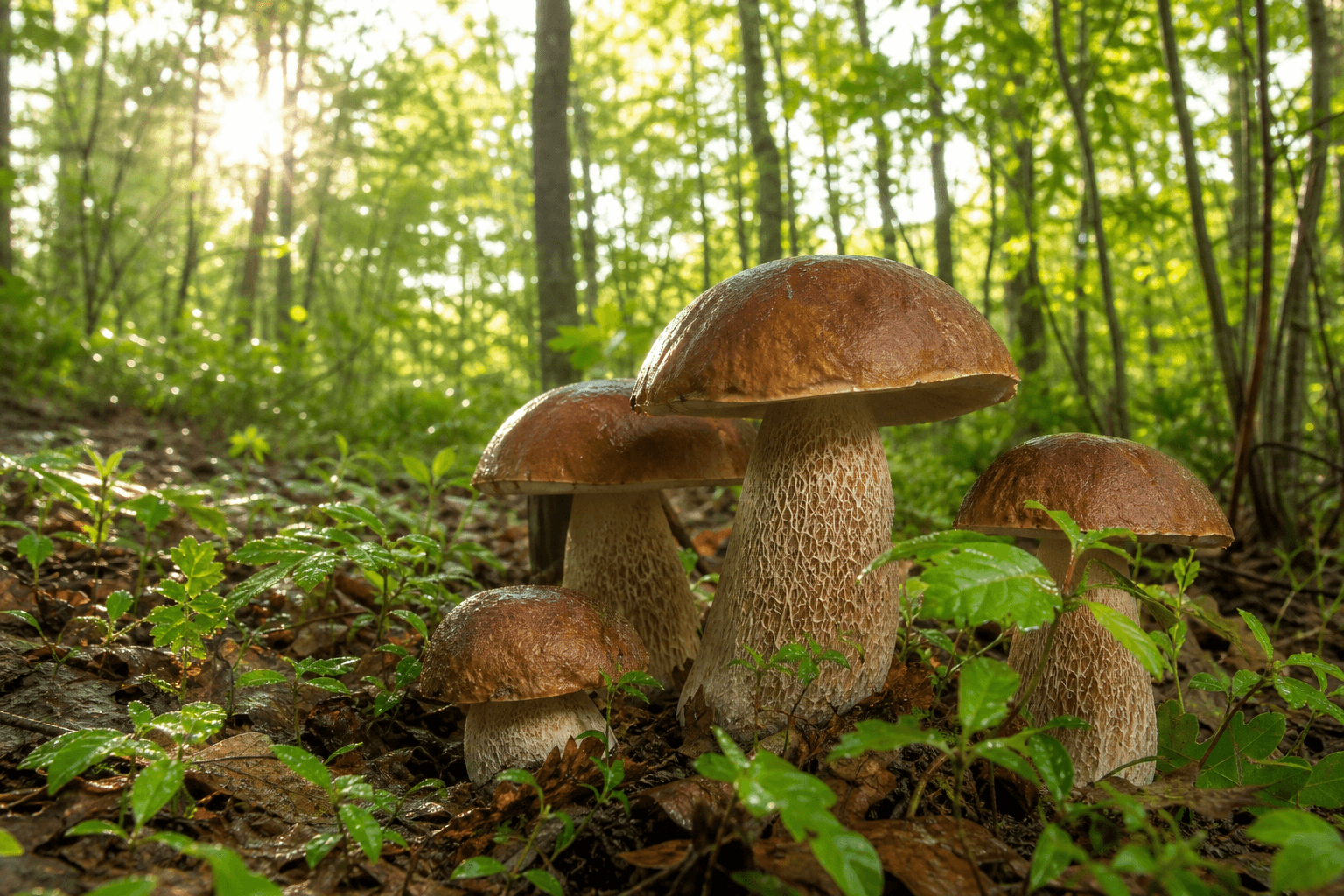
The first May porcini: where and when to find the early cep
The summer cep is the earliest porcini. Timing, locations, weather and how to tell it from look-alikes.
10 min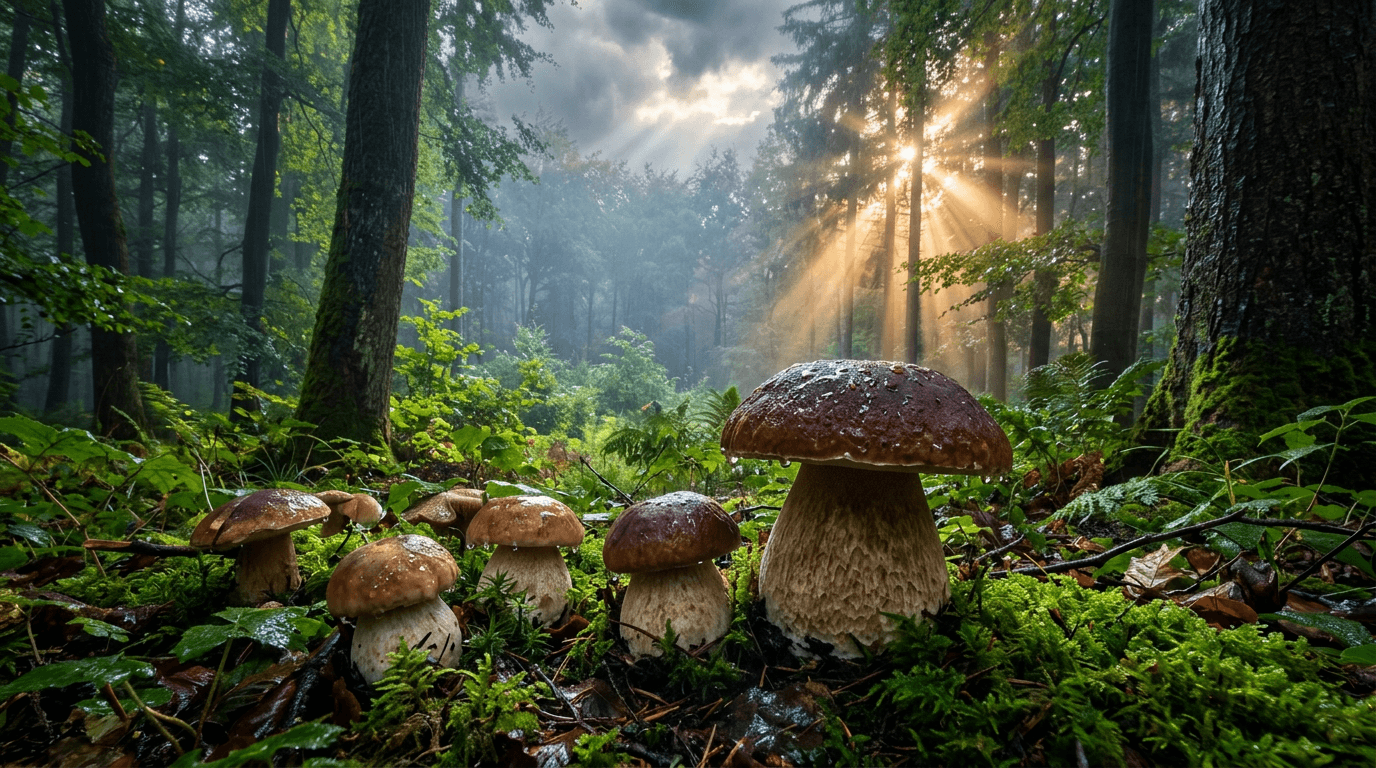
Weather for mushrooms: at what temperature and humidity mushrooms grow
Which weather conditions are ideal for mushroom growth. Temperature, humidity and rainfall — what matters most.
12 min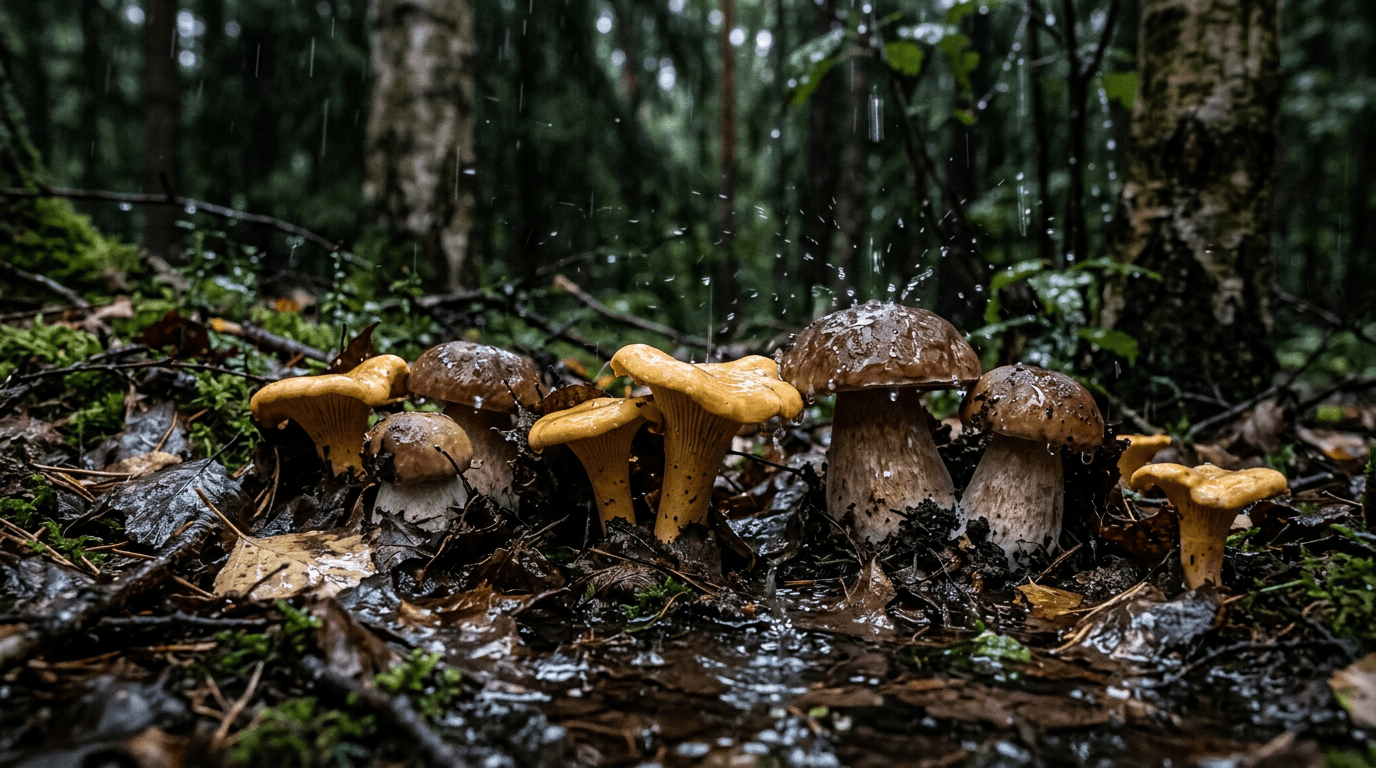
How many days after rain do mushrooms appear
The best windows after rainfall for different species. Ceps, chanterelles and honey mushrooms each have their own timing.
8 min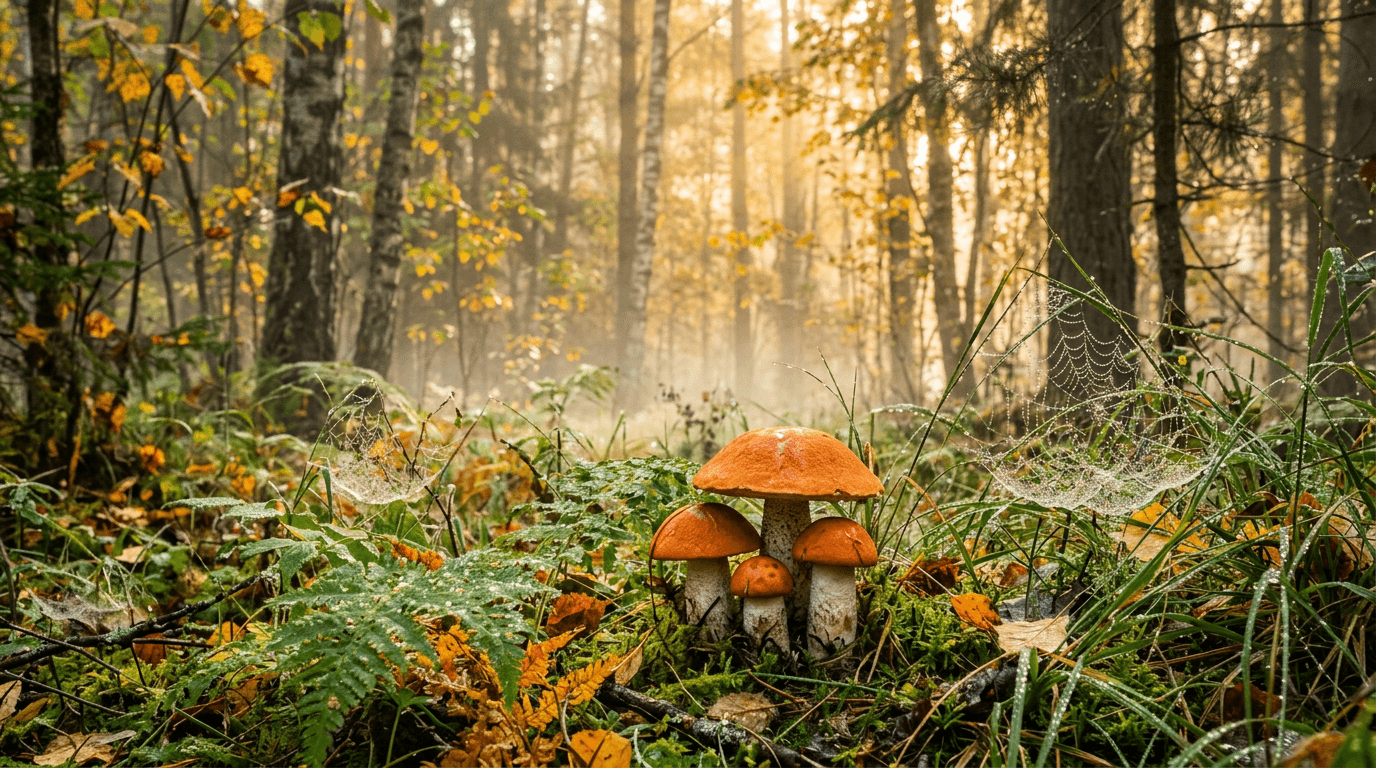
When it's time to head to the forest: 7 signs the mushrooms are up
Practical signs that the season has started. Soil temperature, first finds and other clues.
6 min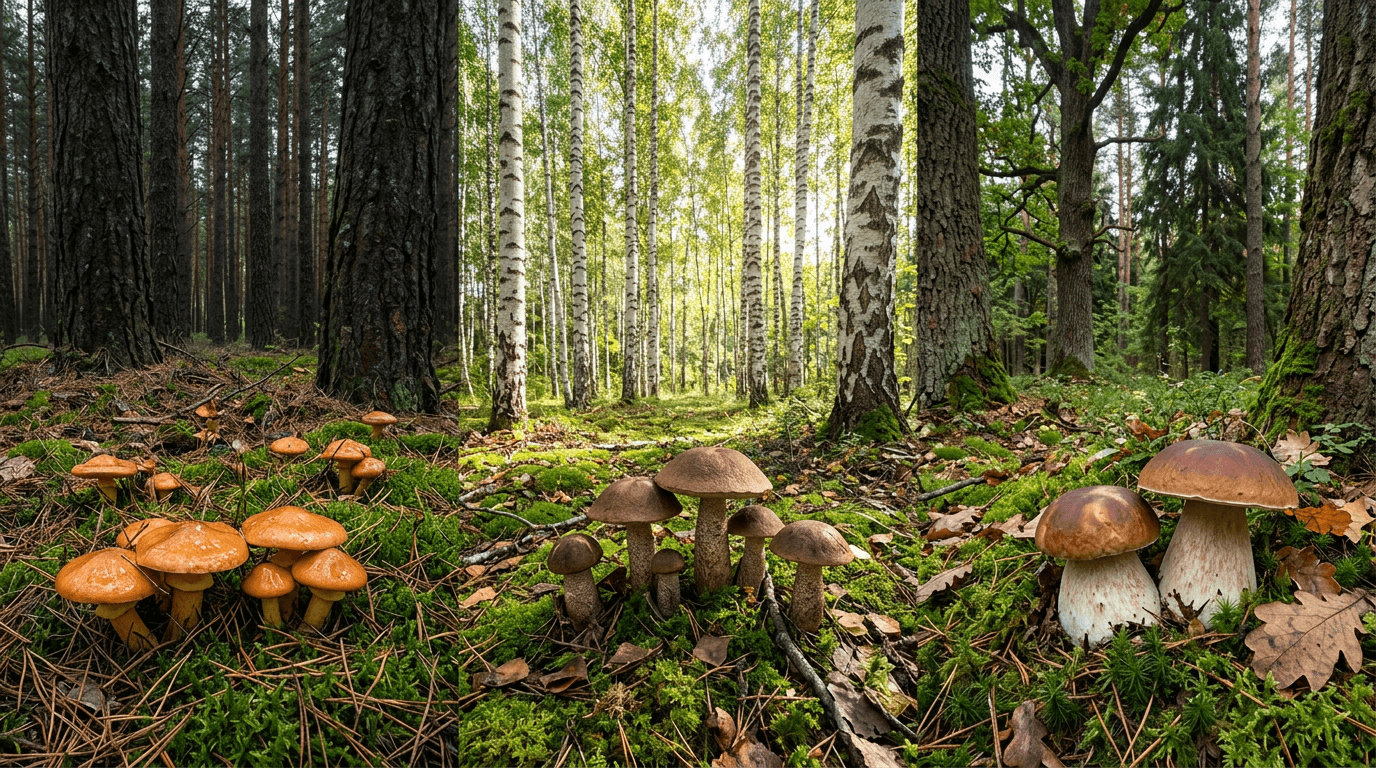
Which forest to search for mushrooms: coniferous, deciduous or mixed
Which mushrooms grow where: ceps in pine forests, birch boletes near birches. A guide to forest types.
10 minYour mushroom spots — with the weather on your side
SkyForest analyzes the weather for each of your locations and tells you when it’s time to head into the forest. Save coordinates, track conditions, and discover new spots on the marketplace.
Try SkyForest →